

The title of my report last month was, “Slaying the federal Leviathan.” And, as promised, this month I am tackling the sequel in my Leviathan series, this one on our protracted dispute with the Evangelical Presbyterian Church, which just ended.
On January 26, the legitimate members of Beverly Heights voted by an 89% majority to depart from the EPC, the denomination we were affiliated with for the last 18 years.
After some back-and-forth last month, representatives of the Presbytery of the Alleghenies (POA) – the EPC’s governing body in this region – voted to accept the congregation’s vote declaring our independence.
Free at last, free at last, thank God Almighty we’re free at last!
With their vote and ours, two years of standing firm on the truth – amid much rancor and heartache – came to an abrupt end.
Church schisms are so commonplace these days, they barely seem to merit mention. But this one mattered more. It was the first church schism I’d ever seen up close and personal. It mattered to me, my family, my church family. The POA invaders had pillaged our church home.
A story as complicated as this one deserves a final reckoning. Though this account is not especially uplifting, and written from my vantage point, we know as Christians that God takes sin and turns it into something beautiful, as He has in this instance. There’s a happy ending to the story, but you’ll have to wade through the messy bits to get to it.
Whenever the body of Christ splits, Jesus weeps. But you know what also grieves Jesus? Untruth.
This account is the best obtainable version of the truth God has enabled me to provide. It is based on having attended most of the meetings described here; a reading of literally thousands of document pages during this ordeal; and countless conversations I had with dozens of persons involved in this dispute. It took about 40 hours to write it, and two plus years to live it.
Not many churches I am acquainted with would have been as steadfast defending truth as Beverly Heights was.
Our chief adversary was the five-man Administrative Commission (AC) which the Presbytery had established to restore “peace, unity, and purity” to Beverly Heights (ironically, in retrospect). It is my considered assessment that the AC put procedural and administrative vengeance ahead of the restoration of “peace, unity, and purity” – or the pursuit of truth.
On January 23, three days before the congregational vote, the AC made one last ditch effort to assert its control over Beverly Heights by removing from office both Pastor Devlin and Session, the church’s duly-elected governing body.
But instead of cancelling our leadership – and the vote, which they claimed didn’t conform to their standards – the overwhelming 89% majority (and events immediately afterward) finally convinced the Commissioners and Presbytery that they had no alternative but to admit defeat, and let us go.
“This was an abuse of power,” Senior Pastor Nate Devlin, who’d been in the eye of this hurricane for more than two years, said afterward. “They did not anticipate a Session and congregation with a spine. You cannot endure something like this if you are not people of character anchored in the truth.”
In the end, Almighty God was merciful toward Beverly Heights and our cause of freeing ourselves from the AC’s grip.
Ironically, I also saw God’s mercy not in the unjust ecclesial proceedings the POA had mounted against us but from the civil court to which we had petitioned for protection.
Our final hearing in the Allegheny County Court of Commons Pleas was on February 13. We were in the courtroom of Judge Arnold Klein that day to hear the Presbytery’s objections to our original lawsuit, which had been filed 13 months before, in January 2024. Their objections, and our defense, were never heard.
Judge Klein had just finished listening to a parking-lot dispute in which the two parties had been fighting over ten spaces for five years. When our case was called, he was in no mood for having his time wasted.
Upon learning that the Presbytery would be voting in only two days on whether to accept our declaration of independence, Judge Klein left no doubt about which side he was most critical of.
He said three words that changed the entire trajectory of our dispute, and pithily summed it up. With an exclamation point.
“This is asinine!” he told the POA representatives in his courtroom, attorney Forrest Norman and Administrative Commissioner Roger Rumer.
If our vote was not accepted by the Presbytery in two days, Judge Klein ordered the parties to come to his chambers the following Tuesday to resolve the matter.
After years of false accusations – and no right of due process being extended to us by the Presbytery, nor the slightest hint of mercy – we’d finally gotten some measure of justice.
It had begun years before with a clutch of dissidents saying they didn’t like Nate Devlin, the senior pastor. His chief offense: leading the church differently than they would.
That crime of personal offense is far more commonplace in the Church of Jesus Christ nowadays than His followers may understand. Among those who have felt the wrath of “cancel culture” are ministers, pastors and priests.
Consider that Father Calvin Robinson, a conservative cleric in Michigan with the Anglican Catholic Church, recently had his priestly license revoked by Archbishop Mark Haverland for supposedly giving a “Nazi salute” while speaking at January’s National Pro-Life Summit in Washington, D.C.
“This isn’t about a hand gesture,” one of Rev. Robinson’s supporters said in this post on Instagram. “It’s about silencing a man who boldly stands against abortion, radical ideologies, and the destruction of Christian values.”
Such crimes of “offense” have become more commonplace living in a culture which places “too much attention to our emotions now,” Peggy Noonan observed in this January column.
Emotions “are important,” Noonan wrote, “part of our human makeup, but at some point in the 20th century we got the balance wrong.” We put emotions ahead of reason, Noonan said. She’ll get no argument from me on that point.
This tendency to ignore thought and overemphasize feelings is a problem common among churches, especially those trending in a liberal direction such as the EPC (which faces the immediate prospect of hundreds of churches leaving over the possible ordination of gay “celibate” ministers).
Offending the wrong people matters more among “country club churches,” which Beverly Heights once decidedly was. Churches which get a higher share of their donations from a handful of wealthy individuals are more prone to placate those who have money, out of sheer budgetary necessity.
Offending the wrong people pushes many pastors out of the pastorate. Only one in ten pastors make it to retirement, statistics say.
Based on my observation, in the EPC right now offending the wrong persons – especially if you have the audacity to claim you are standing on God’s truth – can terminate a pastoral calling. It almost was the end of Nathanael Devlin’s ministerial career.
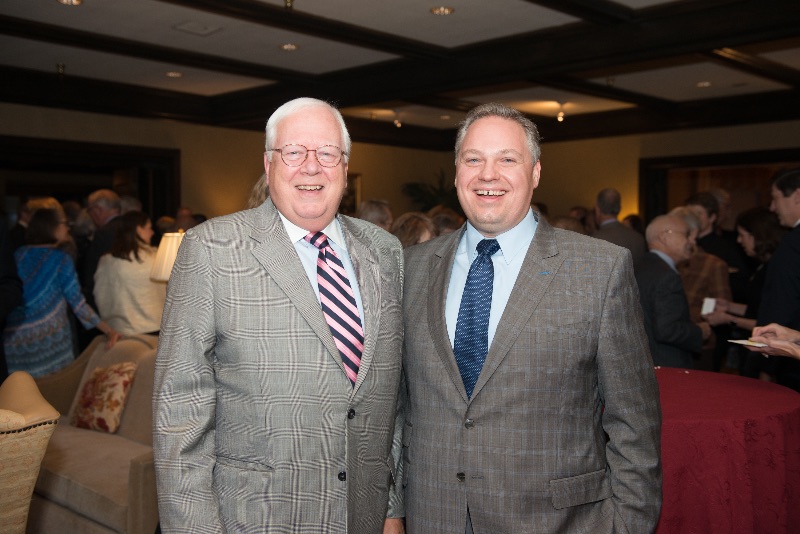
The man Nate replaced was Rick Wolling. He was one of the fortunate few who had made it to retirement after nearly a half century as a Presbyterian minister.
I recall Rick’s retirement banquet fondly. Held on October 19, 2018, at St. Clair Country Club, it was a sumptuous and splendid affair.
After 33 years at the helm of Beverly Heights, Rick was celebrated in a manner few pastors are ever feted. I was among the celebrants.
The column I wrote about Rick, and read publicly on that occasion, was published two days later in the Sunday Pittsburgh Post-Gazette. They were words I sincerely felt at the time. So did Nate, judging from his smile seated right in front of me, as I read the column to the audience on that Friday night.
The article was accompanied by a photograph (below) of Rick who’d spoken at my daughter Erin and groom Scott’s wedding the year before.
Nate had been Rick’s hand-picked and groomed successor, and they had similarities – each drove a pickup truck, for instance. But in actuality, they were very different men.
The biggest difference I’d observed was in their managerial and pastoral styles. Rick tended to avoid problems while Nate ran toward them, like a fireman rushing to a fire. And I know – my Dad was one!
As I would come to learn, running toward problems can be problematic in a church where the wealthy pulled the levers. The people in power were not the least bit accustomed to thinking there were problems or, worse still, that they might be causing them.
What church doesn’t have problems? And no one likes hearing that his or her troubles may be the result of the most likely culprit: their own sinfulness and pride.
Truth be told, Beverly Heights was a prideful place then. Its members felt they belonged to an “exceptional” club (I too was guilty of such pride). “Beverly Heights exceptionalism” was even part of the church vocabulary.
I’ve often wondered if pride might have been part of what the Lord was disciplining and seeking to extinguish.

Nate’s pastorate commenced on November 1, 2018. My time as his director of communications began a month later.
The first year or so passed smoothly, with barely a ripple. That is, until Covid hit early in 2020. For two months, in-person worship services were suspended. When communal worship restarted in late May, a minority (but vocal segment of the congregation) was very unhappy.
They felt strongly that the safety measures then in place (social distancing and optional masking) were insufficient precautions. They were insistent that in-person worship should not resume under any circumstances. Nate, on the other hand, made it clear that God wanted them in the pews on Sunday. They felt they’d been bullied.
The group – including several members of the Policy Committee who were charged with handling personnel matters – initiated an uprising of sorts through a “performance review” that Session hadn’t authorized and Nate hadn’t participated in. They contacted Rick Wolling to see if he would support them. Rick was still part of the church leadership as pastor emeritus (which the EPC had advised against in 2017, when I served on the committee that called Pastor Nate).
Rick listened to their complaints, but didn’t support them. The “coup” fizzled. In September 2020, I was in Nate’s office shortly after Rick had informed him of the situation. Several of those who departed then later claimed to retain voting rights years after they had left of their own volition. The departure of some from this first group would become a major bone of contention much later in the disagreement about who was entitled to vote.
Soon thereafter, a new narrative about Pastor Nate began quietly circulating in the corridors of Beverly Heights, spun by people who were unhappy but had remained.
Nate had begun wearing a clerical collar, which some parishioners found offensive, oddly I thought. Who would object to your spiritual leader identifying himself as such? But that had been the point all along – they didn’t consider Nate their spiritual superior. Far from it.
I suppose coming from a Roman Catholic background, my opinion differed from that of some peers. I did not find it offensive that my minister had a higher rank than I did. That’s among the reasons a believer goes to church, to be counseled, discipled and on occasion corrected by those above you. (I later researched the subject and discovered, much to my surprise, that Presbyterians in the Church of Scotland invented clerical collars as a priestly garb, not Roman Catholics.)
Detractors who had chosen to remain at Beverly Heights labeled Nate as a “bully” and “narcissist” who was unkind. The departure of two disgruntled church employees in the summer of 2022 threw more fuel on the fire of these claims. Shortly after resigning, one departing employee posted to social media (on August 7, 2022): “You can’t ‘work through’ problems with a liar, manipulator or narcissist.”
Nate tried to quench these allegations, but the fire was burning. He wanted to talk to those offended persons individually, but his overtures were rejected.

Although the complaints about him were largely lodged anonymously, a concerted campaign was gaining momentum to oust Nate.
It was led by three dissident elders (one of whom served on Session). As the eleven other elders on Session listened to the narrative in November 2022, and later investigated, they determined their claims were false. They refused to be swayed by the dissident group. Afterward, the demands grew louder and the gossip got more malicious and malignant.
Rick was again contacted to see if he’d support them. And once more, he declined.
Even though the trio had promised Session – their superiors – that they would not take the matter further, they reversed course and took their complaints directly to the Presbytery.
In May 2023, the Presbytery proposed mediation between the dissident elders and Pastor Devlin. “As the Spirit has worked in us,” they wrote rejecting mediation, “our position has evolved … to the point we believe the best thing for [Pastor Devlin] and Christ’s Church is for him to resign or be removed.”
That summer, after a particularly contentious and painful congregational meeting in June during which each elder on Session spoke about the situation, Rick Wolling had begun to provide regular pulpit supply at nearby Peters Creek Presbyterian Church (another EPC congregation which had gone through its own schism years before, when it disaffiliated from the PCUSA as we had in 2007).
Soon thereafter, Rick told associates that he and wife Mary would no longer be worshiping at Beverly Heights. Several dozen people unhappy with Nate followed Rick to Peters Creek.
About that same time, in August 2023, the Presbytery got more involved.Although other inquiries had found that none of the dissident complaints merited sanction against either Session or Nate, the Presbytery convened a panel of five “Administrative Commissioners” (the AC) to further assess the situation.
For six weeks, from their commissioning on August 1 until when they issued their report on September 16, the Commissioners conducted their fact finding.
At the time, I was optimistic. I thought we’d finally get a fair and impartial hearing. The Commissioners would be independent, I reasoned, and not excessively swayed by the complaints of those who’d departed or the few who had chosen to stay but remained unhappy.
How wrong I was.

There were early signs which, in retrospect, signaled that their inquiry would not be fair, balanced or impartial.
The most blatant sign was the amount of time the Commission devoted listening to those with complaints (a minority of the congregation) compared to those who supported Nate and our elders on Session.
In the two-hour “Focus Group” meeting my wife and I attended on September 2, 2023, each person was limited to three minutes of comment. Nate’s wife Holly was in the same group we attended; she too was limited to three minutes, which struck me as odd (especially if you were assessing the “feelings” of those involved in the schism – Holly and others cried during their testimonies).
Our group preceded a separate meeting during which the time spent with one person (who had resigned from staff the year before) was only slightly less than the entire time allotted to about 20 of Nate’s supporters at our single meeting. In addition, multiple meetings were convened at other church locations to listen to those with complaints, including Peters Creek Presbyterian.
In retrospect, it appeared to be a classic example of “confirmation bias.”
“It looked like the Commissioners were only interested in the hurt feelings of past congregants,” my wife Louise wrote afterward. “They didn’t seem interested in the simple truth that Beverly Heights, now led by Nate, was a godly and Christ-filled church.”
When the Commissioners issued their report on September 16, my fears were fully realized. But in my worst premonition I didn’t conceive of how badly they had botched their task.
The “Actions and Recommendations” report they read that day was an abomination.
It strongly suggested Pastor Devlin was an alcoholic, based solely on the claims of his detractors; that he was in need of psychological evaluation, again based solely on the claims of his detractors (due to the “charge” of narcissism); that he had purposefully and intentionally impugned the character of his detractors, again based solely on their claims.
At that time, I thought that if I were to write a book about their actions and their behavior – the accusers and the public transmitters of this defamation, the Commissioners – I’d have titled it Vendetta. To this day, I cannot for the life of me understand or explain why Nate Devlin was attacked as viciously as he was. It’s the question I have sought to answer throughout this ordeal.
Especially aimed at a man who previously had served (with distinction, as I understood) as the Moderator of the very Presbytery that was now vilifying him!
I had been present that day, listening as the five Commissioners sat stone-faced on the chancel of Bethel Presbyterian Church in lovely Enon Valley, Pa., about an hour northwest of Pittsburgh. More than 100 Presbyters and observers from the POA listened as the Commissioners delivered their first verdict of guilt, though no trial had ever been held.
Each of the five Commissioners took turns either making introductory comments or reading from the entire four-page report.
The report described a person who was unrecognizable to me, who I’d known for 20 years and worked under for five. The amiable person I knew sounded like a monster, according to the report’s stark depiction.
Several months later, I wrote: “My immediate thought at that moment was that the Commissioners’ treatment of our pastor and elders on Session (two of whom were also present, Dean Marshall and Todd Loizes) and our church was unconscionable.
“There was no due process whatsoever extended to Session or Nate, just judgments and edicts formed without any opportunity to cross-examine evidence or testimony. There was not even the most basic courtesy extended to Nate warning him beforehand of what was to transpire.”
Nate’s assistant Peter Chace, whom I’d sat next to that day, recalled: “I read halfway through that document and I remember [thinking], the Administrative Commission has failed. … This whole process has failed. That was truly discouraging. … I was humiliated for [Nate], but for me that was one of the most discouraging moments in ministry I’ve ever had.”
The report was received by unanimous voice vote of the Presbyters in attendance. There were no questions asked. They seemed more interested in getting to lunch on time than questioning what they’d witnessed.
As a personal matter, and First Amendment absolutist (as a former journalist), I couldn’t believe that the Commission had the audacity, as part of their edicts, to demand that Nate “immediately suspend association or communication with the Theopolis Institute and Rev. Peter Leithart,” one of the foremost theologians of our time.
The demand was made solely because of complaints from the dissident group who clearly had no familiarity whatsoever with Dr. Leithart and his work (though the suspension was later rescinded by the Presbytery upon further evaluation).
The entire report seemed written with the sole purpose of placating the dissidents who had made it clear that nothing short of Nate’s and Session’s immediate cancellation would, in their eyes, satisfy their demands. All because the Beverly Heights leadership wasn’t leading the church in a manner they approved of.
I made up my mind then and there that if our church didn’t leave the EPC, I would. Without hesitation.
I didn’t want membership in any organization that felt it was perfectly normal or permissible to treat a pastor in the shameful way the AC had treated Nate Devlin. Most of my fellow congregants clearly felt the same. Their conviction regarding the injustice that had been done was demonstrated in the 89% vote on January 26.
The administrative inquiry had been a disgraceful sham.
In his opening remarks, Commissioner Rumer had excused the group by saying they hadn’t been part of an Administrative Commission before. That being the case – and given the clear division of opinion about the situation – you’d have thought they would have conducted themselves with more caution and restraint. You’d think.
The Commissioners had signaled to those in attendance that it was open season on pastoral hunting and hurting. Nate might as well have been Pastor Piñata. Then again, the Commissioners had clearly established that the “feelings” of one disgraced clergy member didn’t matter. Not in the EPC at least, and not in this specific instance.
As bad as the reading of the report had been, perhaps the worst moment came shortly afterward.
It came in a wisecrack from one of the dissidents who was present that day. When Nate reentered the church, moments after the report had been read, he was taunted by one of his own parishioners.
The person asked: “Where’s your collar?”
The time immediately afterward was the lowest point I had ever encountered in any organization, secular or religious.
The die had been cast. This had quickly escalated from what should have been a fairly straightforward ecclesial inquiry into a blood feud. It had become a fight for survival.
Nate himself was bludgeoned and dazed.
Three days after the report was read, when he and the Commissioners held a follow up meeting via video, Nate asked, “So I’m not guilty of anything?” Commissioner Rumer replied sternly and menacingly: “Not yet.”
At the annual Congregational Meeting on September 27, 2023, the dissidents who hadn’t been admonished and told to depart from Beverly Heights (and still held membership) continued to press their case. Afterward, they vigorously complained to the Commissioners about the conduct of the meeting and the statements both Nate and Elder Marshall had offered, which they judged insufficient. The Commissioners eagerly took their bait, acting before they’d even bothered to verify if what they’d been told was true.
Reacting to this clearly choreographed barrage of complaints from the dissidents, the Commissioners on October 3 issued a significant ultimatum via email to the Session which would impact all events that followed.
Notify us by October 12 if you intend to comply with the report as written, or if Session intends to seek dismissal from the EPC.
It had become abundantly clear to Session that no amount of cooperation would be sufficient or accepted, and that our congregation was in complete and absolute misalignment with the EPC. Session wisely chose to seek dismissal.
The Commission had set up a Catch-22: they were blocking our departure while admonishing us from publicly revealing why we wanted to leave, as we did in this post and many, many others.
It was also crystal clear to me at that time that nothing less than the cancellation and removal of both Nate and Session would be sufficient penance for the supposed sins we’d committed.
Even though we owned our property – we’d secured full title to it in our prior dispute with the PCUSA – Beverly Heights would effectively be controlled by the Presbytery if Session and Nate were removed. A puppet Session would be installed once our adversaries gained control of the church. Though the Administrative Commission denied this repeatedly, that was clearly their hidden agenda. They wanted to “recapture” the church (and its considerable assets) on behalf of the dissidents who’d be beholden and loyal to the Presbytery.
At that point, Beverly Heights as we knew would cease to exist. The independence we had fought so hard to win in our earlier dispute and negotiations with the PCUSA would be vacated.
The Administrative Commission may not have been inclined to show mercy, but God was in our valley of despair. Corporately and individually, He met our needs.
That was profoundly demonstrated in the events that followed in the fall and early winter of 2023-24, which set the course for the freedom we eventually gained in February 2025.
In our encounter with the Living God, we underwent the corporate equivalent of being “born again.” The coming of that conversion had been foreshadowed in the events which preceded the reading of the Commission’s report on September 16, but it hadn’t yet happened.
And in its happening, it illustrated the very point I have learned again and again in my own personal walk with Jesus Christ. I had learned it most potently and profoundly, on a life changing scale, a quarter century earlier.
You have to lose your life to find it.
Once that recognition was made, that through loss and sacrifice comes gain, the events themselves occurred in rapid-fire succession as God’s will for Beverly Heights and His people unfolded in a divinely orchestrated plan.
In October 2023, Nate Devlin resigned as the senior pastor of Beverly Heights Church. In his resignation message to the congregation, he explained “why I am not an EPC pastor.”
At that point, the odds of Nate returning as our pastor seemed pretty remote. I recall telling one person that I thought it was 5%. I had forgotten that death always precedes resurrection.
As painful as Nate’s resignation was, his departure turned out to be a critical turning point. Staff and Session had to shoulder the burden of his departure in his absence.
Three people in particular emerged as leaders in the vacuum that Nate’s departure had created: Peter Chace (who became our expert on EPC polity and governance) and Dr. Kyle Bennett, Nate’s deputies who stepped up to handle the preaching and teaching duties; and Andy Lucas, the clerk of Session who became the point person in our quickly deteriorating relations with the POA.
In November, as discord with the Commissioners intensified over who would be entitled to vote in the disaffiliation election scheduled for February 2024, Session wisely decided to explore our legal options. I was asked to search out attorneys experienced in this narrow field of ecclesial litigation. The recommendation I made was an attorney who had represented us as the junior counsel when we’d left the PCUSA in 2007, Frank Kosir Jr.
In December, as the dispute over the voting rolls intensified, Commissioner Rumer informed Session that the Commission was done listening to challenges to its authority.
“The AC believes there are abundant grounds to substantiate charges of contempt against [Teaching Elder] Devlin and each individual member of Session for not abiding by the actions and recommendations of the AC received by Presbytery on September 16th,” Rumer wrote.
“While the AC is grieved to have to recommend ecclesiastical charges, we believe we have been more than patient in doing so.”
Our position was that the AC had given us a binary choice – comply with the Actions and Recommendations report, or seek dismissal. We had chosen the second option, the dismissal route. In fact, according to the EPC Constitution, protections exist which prohibit retaliation against congregations in the midst of the departure process.
But the Commissioners contended that our case was a special situation and the rules didn’t apply.
At that time, I often thought how ironic it was that the very thing Nate had been accused of by the dissidents – being a bully – was how the Presbytery and Commissioners behaved toward us. Several times over.
When the Presbytery approved on December 28 that contempt charges be filed and an ecclesial proceeding commenced against Pastor Nate and Session, it played the only card it had to compel us to comply, as they had no legal claim on our property. But in doing so, it opened the door to Nate’s return.
Despite what his opponents claimed, Nate actually had a very high view of ecclesial authority. Respectful of the Presbytery’s authority over him, Nate had resigned not to be held in contempt. But at the same time, he couldn’t violate his conscience. He couldn’t live a lie.
Now that he’d been charged with contempt – from a body he thought he’d resigned – he rescinded his letter of resignation when it turned out that the Presbytery hadn’t officially recognized his resignation. Session unanimously and happily welcomed Nate back in January 2024.
And when we filed our lawsuit against the Presbytery that same month, the balance of power tilted toward us and away from the Commissioners and the POA.
The Presbytery had assumed that the Allegheny County Court of Common Pleas would not be inclined to get involved in a church dispute. That assumption – first asserted publicly by EPC Moderator Dean Weaver when the AC was formed on August 1, 2023 – turned out to be dead wrong.
Our attorneys, Frank Kosir Jr. and Jaden Rankin-Wahlers of the Meyer, Unkovic & Scott firm downtown, had sought an immediate hearing on the emergency motion they’d filed to prevent the Presbytery from exercising any control over the membership rolls of our church.
Pennsylvania non-profit law was on our side. It clearly stated that such control resided exclusively with the Session (so, ironically, did the Presbytery’s own bylaws).
While there were no guarantees that the judge would rule immediately, or in our favor, God was walking with us. On both scores, we won immediate victories.
With the disaffiliation vote originally scheduled for February 4, 2024, Judge John McVay Jr. – the first of three judges who presided over our case during the 14-month litigation – was persuaded that the situation was indeed urgent, that Pennsylvania non-profit law applied, and that the facts in the case merited further examination.
At the hearing held one day later, he immediately enjoined the Presbytery “from taking any of the following actions: (1) adding members to the membership rolls of Beverly Heights Presbyterian Church, (2) removing members of the membership rolls [of the same], and (3) restricting the voting rights of the existing members [of the same].”
The temporary injunction had been granted. The Commissioners and the Presbytery were no longer calling the shots. They now had a civil superior that outranked them, to which they’d have to answer.
In his groundbreaking book, Slaying Leviathan, church historian Glenn Sunshine tells the story of what has come to be known as “Protestant Resistance Theory.”
Reading the book recently, I wrote in the margins: “Though I grew up in the Roman Catholic Church, I am at heart a Protestant” (which would likely appall my Irish-Catholic ancestors).
The chief reason I am a Protestant at heart is that I believe, to my core and innermost being, Lord Acton’s famous admonition: “Power tends to corrupt and absolute power corrupts absolutely,” which Acton wrote in a letter to Bishop Creighton in 1887.
This adage applies not just to governments but every powerful institution, including the Church when the restraints on power are insufficient to curb Leviathan-type excesses. I have already described above what can happen when powerful people perceive that their power is absolute. It is a corrupting influence which corrupts absolutely.
In this regard, I concur entirely with the sentiment expressed to me in a recent email by my friend, Dr. T. David Gordon.
Reflecting on the situation we encountered with the Commissioners and the Presbytery, he wrote: “Individually, I am confident that most of the men in the EPC and POA are good men, good servants of Christ and his church; given authority, however, it perverts them, and brings out their worst (as it does me).”
T. David pointed out the ultimate irony in the famous Acton quotation cited above: Acton was a Roman Catholic, and had written it to Creighton, an Anglican.
The corrupting influence of power then in the Roman Catholic Church had sparked the young Catholic monk, Martin Luther, to trigger the Protestant Reformation. We all know the story: Luther hoped that the document he posted in 1517 would spark academic debate. Instead, his Ninety-five Theses ignited a conflagration that would forever destroy the world he knew.
By 1521, Luther was a marked man. Pope Leo X excommunicated him and issued a standing order that he be summarily executed if found. There would be no Protestant churches today without Luther’s courageous stand, which was rooted in a simple premise: that only God has authority over our consciences.
In his book, Sunshine meticulously and brilliantly lays out the case for “Protestant Resistance Theory.” Which may sound high minded but had direct application to the situation we faced with the Presbytery.
“God alone has authority over our consciences,” Sunshine writes in the book (page 76), “and thus they are bound only to the Scriptures, which sets our consciences free in Christ. Should any earthly power, civil or ecclesiastical [my italics added], claim authority over our consciences, then we are obligated to disobey that power even at the cost of our lives.”
The sentiment expressed in this quotation had great significance for us in our dispute with the Commissioners. Rarely had I observed a group of men who were more blinded by their power than the Commissioners were toward us. And that’s saying a lot as I have spent a professional lifetime observing men blinded by power.
For me, Pastor Nate and our elders on Session, there was complete unanimity on this point. The Commission’s edicts did not nullify Pennsylvania law, under which the Session was the sole arbiter of the voting rolls. And it was also crystal clear that once a member had been moved to “inactive” status (after not attending worship service in our sanctuary at least once in a year, hardly a demanding standard), they were notpermitted to vote. Their emotional or retributive claims did not matter. That was the legal standard, plain and simple.
This was the crux of the dispute with the Presbytery, which wanted to cut corners for those who were angry. The Commissioners claimed that former members (some of whom hadn’t worshiped at Beverly Heights in many years) were still eligible to vote. Actual records (which the Presbytery had inspected and certified before membership had been disputed) did not support their position.
Our conscientious objection was also supported by many people I respected, including Dr. Gordon, an ordained Presbyterian minister who formerly pastored a PCA church in New Hampshire as well as retired professor of religion at Gordon Conwell Seminary and Grove City College.
In another email to me, he summed up the subject of “contempt” quite nicely:
“American Heritage defines contempt as: ‘Open disrespect or willful disobedience of the authority of a court of law or legislative body,’ which is precisely what the POA has done regarding your congregation’s lawful meetings and your Session’s lawful meetings. …The congregation has constitutional rights; the Session has constitutional rights, and the POA has shown contempt for both, and then has alleged that both have shown contempt for them, in an ecclesiastical version of ‘the pot calling the kettle black.’ ”
Throughout the administrative process, the Commissioners never backed down. Not one inch. Perhaps, in their hubris, they consider that a victory. But there can be no disputing that the process didn’t bring the intended “peace, unity, and purity” to Beverly Heights.
Instead of backing down, they doubled down. By November 2024, they’d finally initiated their long-sought quest: to bring our Session and pastor to heel in an ecclesial trial, for failing to act on the original actions and recommendations contained in their report (they were hardly “recommendations”).
The ecclesial trial began on Saturday, November 23 at First Presbyterian Church in Beaver. The proceeding was recessed after eight hours that day when the three Presbytery Commissioners presiding over the trial thought they sensed a “Christmas miracle” at hand.
At their urging, the parties agreed to once again try to mediate the dispute – a prior court-ordered mediation in March had previously failed, presided over by a professional mediator and retired judge no less.
This mediation, too, proved unsuccessful. It never even began. When the parties reconvened after a seven-week recess on Saturday, January 11, 2025 – about one year after we’d sued the Presbytery in the Allegheny County Court of Common Pleas, to stop their encroachment on our church – Nate Devlin delivered his closing statement.
Nate’s words that day were moving and profound. Here’s part of what he said, moments before being pronounced guilty for contempt with an added charge in his case of immorality (just to settle scores once and for all).
But in his close (which you can read in its entirety here), Nate hardly sounded contemptuous or immoral.
“I have been in pastoral ministry in one form or another since 2000. I was a church planter for five and a half years in a small Rust Belt town outside of Weirton,” Nate pleaded.
“My wife and I lived in Section 8 housing as I worked three jobs to raise two small children and pay for seminary. I navigated with Beverly Heights our exit out of the PCUSA, and followed a long-term pastorate of 33 years. I had to learn how to pastor through a global pandemic.
“All of these experiences were challenging,” Nate continued, “but I can say unequivocally the last two years of conflict with the POA have been the hardest ministry years of my life. …
“As I stand before you today, and before Almighty God, I believe every decision that I and the Session have made over the last two years has been in obedience to Christ and for the purpose of leading Beverly Heights Church into the good future that God has ordained for it.”
His plea fell on deaf ears.
While the guilty verdict was disappointing, it had been anticipated.
Session immediately enacted the plan that had been formulated. The congregation was notified the very next day that the congregational vote would be held in two weeks’ time, on January 26.
The Presbytery retaliated by suspending and removing both Nate and Session for “their persistent rebellion and refusal to repent.” Strangely, Nate and Session were not notified of their removal until after the vote even though the action had been taken beforehand. But the Presbytery was unable to block the vote, which was surprisingly brief and calm: 106 members voted in favor to leave the EPC, while 13 were opposed with one abstention.
Our leadership had gone into the process wearing the full armor of God, and He was faithful. We were confident there would be no resurrection of our church without death.
In that sense, the guilty verdict from the POA administrative court was a useful end. Through God’s grace, providence and mercy over a situation we once abhorred, we’d come to a place of serenity. We’d come to recognize the refinement and purity that had been achieved within our body.
Out of the ashes of death, a new Beverly Heights was born. The torch had been passed to a new generation of church leaders. And the bonds people feel with each other far are stronger than ever before. Going through a war will do that, I suppose.
I thought it was significant that on January 26, the day members gathered to vote on the measure that would dissolve our relationship with the EPC and enter us into independence, none who spoke in favor of the measure were members of what I would call the “old Beverly Heights guard.” All who spoke were younger members of our church family. Three were the sons (plus one daughter) of parents who had raised them in our church.
I also found significance in the worship service on February 16, the day immediately following the Presbytery’s vote to release us from the EPC.
By happenstance, Peter Chace was preaching that day. I thought of the first time I’d met Peter in 2019, and all the change – and challenges – he’d faced and we’d faced in the intervening six years.
Back then, Nate was doing his fireman thing, rushing to the Peter fire. Not to put out a fire, but to help light one in Peter. The fire God lit, and Nate helped fan, had culminated with Peter starting and finishing his studies at Trinity School for Ministry and earning his MDiv degree, all while juggling his significant duties at our church, in the Coalition for Christian Outreach, and leading his family.
Peter’s text that day was Isaiah 38, appropriately.
King Hezekiah is sick and dying. He cries out to God and God heals him, but Hezekiah squanders his second chance.
“We are all Hezekiah,” Peter said. “God loves to heal his people and He loves to give second chances.”
“Our church has just come through the waters of baptism. Just yesterday we got through the fiery furnace. We have all been healed of a sickness that was leading to certain death,” he continued.
“He’s given us a second chance. A second chance right here. A second chance to surrender our hearts. A second chance to build our families and our homes. To give them over to Him.
“A second chance to build the Preschool and the Academy and to raise up the next generation of Christians. To build this congregation. To build up the kingdom here in Mt. Lebanon and in the South Hills.”
Our God is indeed a God of second chances. Of that I had no doubt.
Amen. I’ll write again (on another subject entirely) in a month. May God bless you and heal you.
Photo by Humble Lamb on Unsplash
 The Parrhesians