
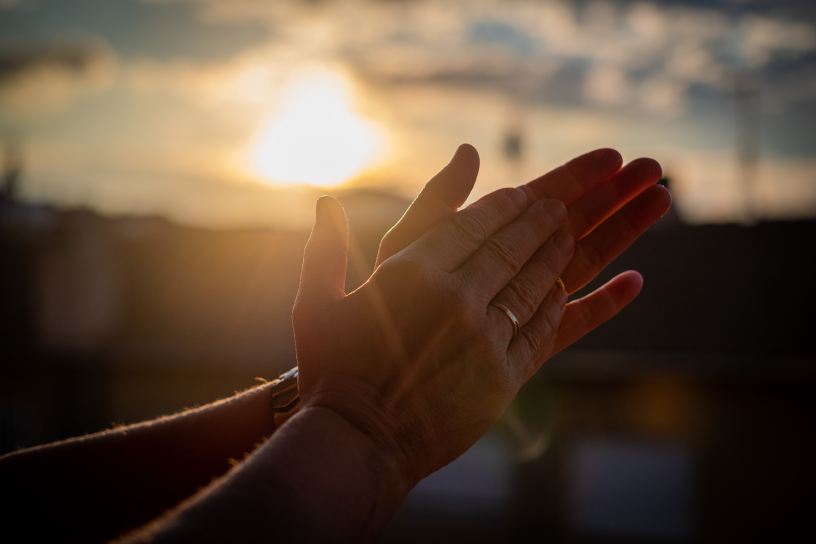
“Clap your hands, all peoples! Shout to God with loud songs of joy!”
(Psalm 47:1 ESV)
For years I kept the following note in the Sunday worship bulletins I prepared, “Please refrain from clapping unless led to do so.” This short sentence created no small amount of curiosity, confusion, and outright consternation in the congregation. Some responded by rightly pointing out that clapping is not only permitted in the scriptures, it is commanded. And so it is, as indicated in the text above. So why the note? Well, the first thing to clarify is that the note is not a prohibition against clapping in church ― far from it. We must clap in church; we must use our bodies in worship by clapping, sitting, standing, and even shouting for joy. Rather, the note is a prohibition against indiscriminate, self-authorized, individualistic expressions in worship that create confusion. The flaw we are trying to avoid is expressive individualism in worship, which can lead to disconnected praise.
Autology Deformes
Carl Trueman, of Grove City College, masterfully traces the roots of expressive individualism in his book, The Rise and Triumph of the Modern Self. In the book, Trueman identifies how and why in the modern world we are educated to be expressive individuals. He writes,
If education is to allow the individual simply to be himself, unhindered by outward pressure to conform to any greater reality, then the individual is king. He can be whoever he wants to be. And rejecting the notion of any external authority or meaning to which education is to conform, the individual simply makes himself the creator of any meaning that there might be. So-called “external” or “objective” truths are then simply constructs designed by the powerful to intimidate and to harm the weak. Overthrowing them—and thus overthrowing the notion that there is a great reality to which we are all accountable, whether that of the polis, of some religion, or of the economy—becomes the central purpose of educational institutions. They are not to be places to form or to transform but rather places where students can perform. The triumph of the therapeutic represents the advent of the expressive individual as the normative type of human being and of the relativizing of all meaning and truth to personal taste.
Carl Truman, The Rise and Triumph of the Modern Self
Our culture is training us to believe that authenticity is the expression of the essential, internal self. We grow to believe that the world is our stage where we get to perform what is inside us. And all of this training comes through the door with us when we come to church. We assume (often unconsciously) that worship is an opportunity for self-expression based on my preferences. If I want to clap, raise my hands or say “Amen!” then I should be allowed to do so (or do none of them), because that’s what authentic worship means to me.
The church, however, is not a stage upon which we perform and worship is not self-expression. Rather, the church calls us to worship God under His authority and according to His design. When we do this, we worship together as one body, not as a congregation of individual selves. I’m sure you’ve noticed, as I have, that there are occasions when it feels like maybe we should clap. Some folks take full advantage; others do not. The problem is that this disjointed response result in confusion and something less than the full praise God deserves. We should clap together or not at all.
Doxology Transforms
The occasion where the congregation most often wants to clap is following a choral anthem or after special music. Usually we have just heard something exquisite and we rightly want to respond with joy. Do we clap? What do we do? What we do is thank God together as a church. One way to do that well is by singing the doxology together. The doxology is the church’s cooperate expression of gratitude. It allows us to be unified, and as we sing it, it helps transform us away from expressive individualism and more and more into the image of Christ.
Photo by Guillermo Latorre on Unsplash
 The Parrhesians