
My father was a contractor while I was growing up. After dropping out of college, he got saved and moved to Pittsburgh with my mother. After the move, my father worked as a draftsman and later sold used cars. When I was a toddler, he decided to go to work for himself and started a small business named T. Devlin Associates.
In the early days he did a lot of remodeling jobs, many of them dirty jobs in the less desirable parts of the city. As I grew older, my twin brother and I became two of the associates in the business, and we helped out on what seemed like countless roofing jobs over the summers. Eventually, in my late teens and early twenties, we started building custom homes in and around the North Hills of Pittsburgh, and the business enjoyed a small season of stability and prosperity. A few years after I was married, my father closed down the business and focused on home inspections.
For much of my upbringing our family was poor. New businesses struggle as a rule, but in the construction business you also have to contend with seasonal highs and lows. Homeowners are more inclined to take on remodeling jobs over the summer and early fall, but after Halloween people are less interested in a new deck or an updated kitchen until sometime after the holidays. As a result, work was often slow around Christmas and money tighter than usual.
The stress of a declining income, coupled with the rising pressure to secure what we needed to celebrate Thanksgiving and Christmas, became a regular feature of our holidays. Over the years, my brother and I began to dread them, because Christmas meant anxiety for my parents and a growing sense of guilt as we opened presents we knew had been purchased under the distress of limited resources.
Eventually my anxiety turned to cynicism. The weeks leading up to Christmas became a time of unholy asceticism: preparing for disappointment and trying to convince myself that Christmas had been overtaken by consumerism, that things like “desire” or “exchange” corrupted the true celebration of Jesus’ birth.
One year my brother and I went so far as to mock our family Christmas tree, declaring it an idol that needed placating with the necessary sacrifices of finely trimmed Christmas presents. A few days before Christmas we knelt in front of the tree and made a great spectacle, in the hearing of our parents, as we beseeched it to grant us peace now that the obligatory sacrifices had been placed beneath it. Part of me was calloused, angry at the annual and seemingly unrelenting pressure of Christmas gift giving. Another part of me suffered in quiet desperation, secretly longing to celebrate, to give and to receive without guilt or worry.
Through my experiences growing up, my attitude about Christmas became malformed. On one level I knew this about myself, but I did not know the extent of the malformation until I became a father and felt the tension between my earlier disenchantment and Christmas morning with my own children. I wish I could say that becoming a father released me from my cynicism about exchanging presents, or relieved the anxiety that comes over me as Christmas approaches. It hasn’t.
What has changed are my practices of preparation. As a kid we didn’t celebrate Advent. There was Thanksgiving, there was Christmas, and there were the weeks of anxiety in between, but no Advent season and no disciplined practices of preparation. Anyone who has worked construction knows that a house goes up only as well as the ground was prepared. I’ve come to learn that in order to celebrate Christmas properly, I have to practice celebrating well and prepare myself to give and to receive.
Now, during Advent, I try to remember the gift given by our Heavenly Father, an extravagant gift given for us, the unworthy. The Father gave all that he had to give by sending his Son, and he did so not out of compulsion or necessity but freely and out of love.
During Advent, I try to prepare room in my heart for Jesus. Jesus is not a burden, though the innkeeper might have thought so, looking at Mary in the travails of labor. Rather, Jesus said, “My yoke is easy, and my burden is light.” Advent is a season to cultivate a longing for Jesus, and that longing helps me make room for my wife and kids and for their gifts. It is a season in which I try to reorder my desires, from a desire to “survive the holidays” to luxuriating in the meaning, the music and the message of Christmas.
For many years I was an offender against the celebration of Christmas, but I believe that by God’s grace, and through intentional practices during Advent, I am being reformed. I am becoming a man who each Advent season is filled with less dread and more anticipation for the celebration of the birth of our Lord Jesus Christ. I am becoming a man who wants to sing with Christina Rossetti:
What can I give Him,
Poor as I am?
If I were a shepherd,
I would bring a lamb;
If I were a Wise Man,
I would do my part;
Yet what I can I give Him:
Give my heart.
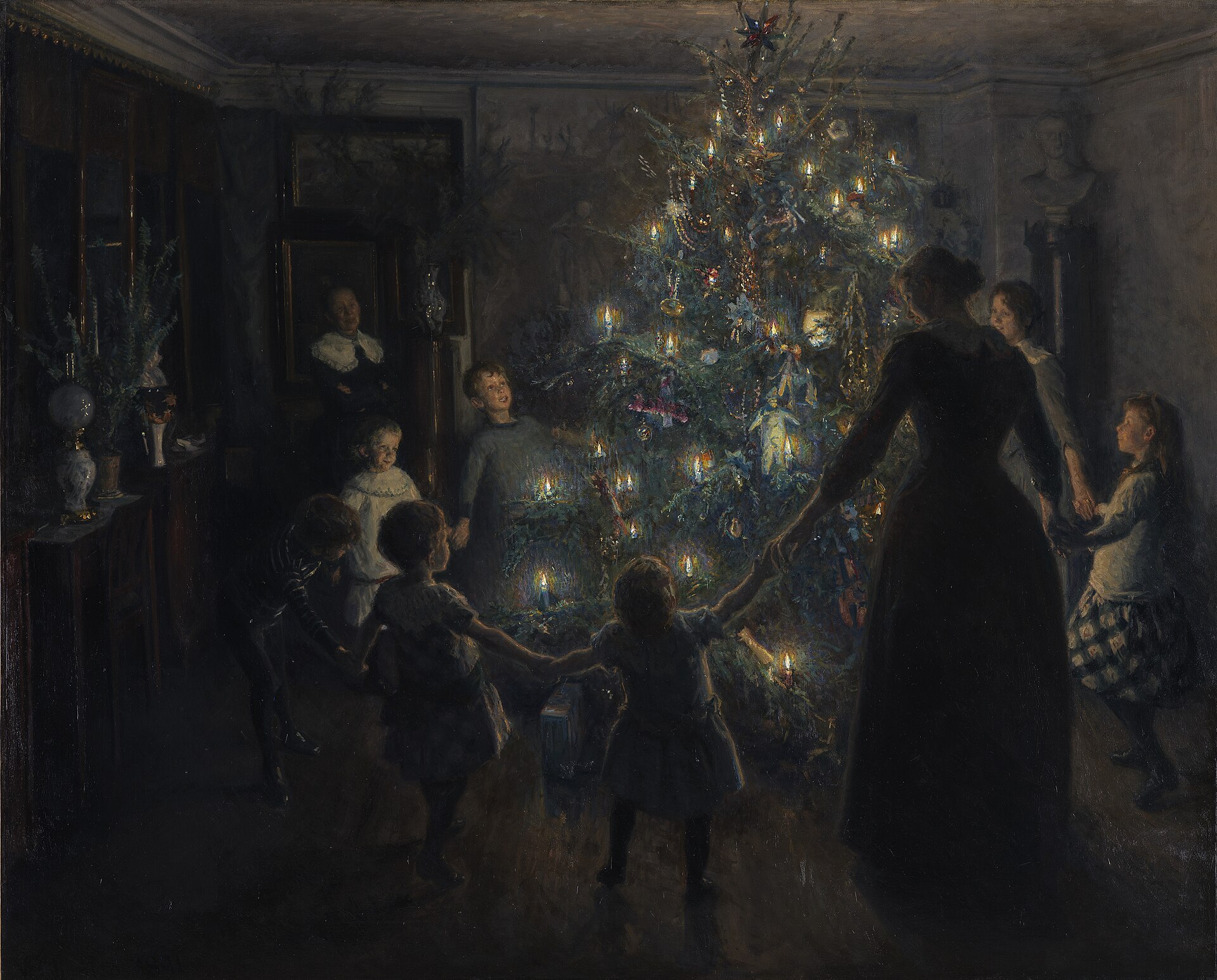
Image: Viggo Johansen, Glade jul (Happy Christmas), 1891. Public domain, via Wikimedia Commons.
