
Thursday, April 23, 2026
Good morning.
Earlier this month, the following email arrived in my inbox from the New York Times. “Why marriage is less appealing than ever,” it said in the message line.
The answer seemed obvious to me without reading a single syllable.
Marriage is less appealing “because they read the New York Times,” I said aloud within Louise’s earshot. While I doubt the Times offered that as an explanation, it is nonetheless true.
The point being: you’re as fatalistic about all topics, marriage included, as the news you consume.
Though Louise laughed at my comment, I wasn’t joking.
Nearly a half century of participating in the news business and observing it has taught me one overarching truth: the news you consume defines your beliefs. In an era of deeply partisan “truth-telling”—which afflicts both Right and Left sources—this reality is more apparent and confusing now than ever.
On the Right, podcaster Candace Owens incredibly claims the widow of Charlie Kirk played a role in his assassination! Tucker Carlson makes the bizarre claim (among others) that attacks on Iranian mullahs who would gladly behead us somehow represent an affront to Christians (a view Pope Leo XIV apparently shares, though not all Roman Catholics or clerics concur).
The claims of Carlson, Owens and others have gotten so unhinged that President Trump called them out in this social-media post as “losers.”
Then there’s those on the Left whose list of falsehoods grow with each passing day. The biggest of past whoppers included that Trump colluded with Russia to win the 2016 election, that Hunter Biden’s laptop didn’t exist, that the Black Lives Matter riots in 2020 were “mostly peaceful,” that the Covid shutdowns and mandatory masking were necessary and that the virus mysteriously sprang out of nowhere, that Joe Biden’s mental acuity hadn’t declined while President.
In this landscape, what is one to believe?
Surely not the Times. No one fed the steady diet of doomsday dystopia it shovels to its readers could be hopeful about anything or the future. Marriage demands confidence in the future.
Theirs is the voyage of the doomed, especially with a supposed maniac like President Trump captaining our ship of state. Yet for someone who is widely lampooned as a maniacal idiot and national disgrace, he sure does seem to be right an awful lot lately, especially on matters of foreign affairs.
Crime in Venezuela is down and folks there are happy since the capture of their outlaw President Nicolas Maduro, who awaits trial on narco-terrorism charges in a Brooklyn jail with his wife.
Then there’s the situation in Iran. Here’s Ben Shapiro’s latest take on the truth, which I agree with.
“Shock of shocks: the panicans [as in those who panic] and the liars are wrong again,” he writes in his latest weekly newsletter. “They said President Trump would never be able to open the Strait of Hormuz; they said that Iran would win this war by simply outlasting us; they said that we would somehow make Iran stronger.”
Thomas Friedman, the Times’ Pulitzer Prize-winning columnist for foreign affairs, finds the situation that Trump may actually win in Iran too much to bear. He said out loud recently the reality that most folks in the legacy news media usually keep to themselves.
Interviewed on CNN, Friedman admitted he’s “torn” about efforts to remove the Iranian regime. “I find myself, Michael, in a situation where I really want to see Iran defeated militarily,” Friedman told CNN host Michael Smerconish. “Because this regime is terrible for its people and the region.”
Iran is a murderous regime no doubt. It has massacred 42,000 innocent protesters this year alone, many executed by public hanging. But …
“The problem is I really don’t want to see [Israeli Prime Minister] Bibi Netanyahu or Donald Trump politically strengthened by this war, because they are two awful human beings,” he said.
I was privy once to how media elites think when I was Times adjacent as a staff reporter for its rival, the Wall Street Journal. Friedman’s remarks reflect the worldview of most legacy news reporters I knew then. And based on what I read now, the problem has gotten far worse since I left the profession.
Friedman, a Jew, incredibly trusts our President less than the horrible leaders of Iran who kill their own, murder Jews, and Christians too. While I commend his willingness to reveal the truth about his ambivalence, it is nevertheless a stunning declaration to consider on many levels.
Where were these same self-appointed “defenders of democracy” when Biden surrogates were running the country? Wasn’t the Republic at risk then? Of course it was. Because they agreed with Biden’s progressive policies and did not want to blow his cover, however, the story was censored by the very institution that is supposed to keep the government in check.
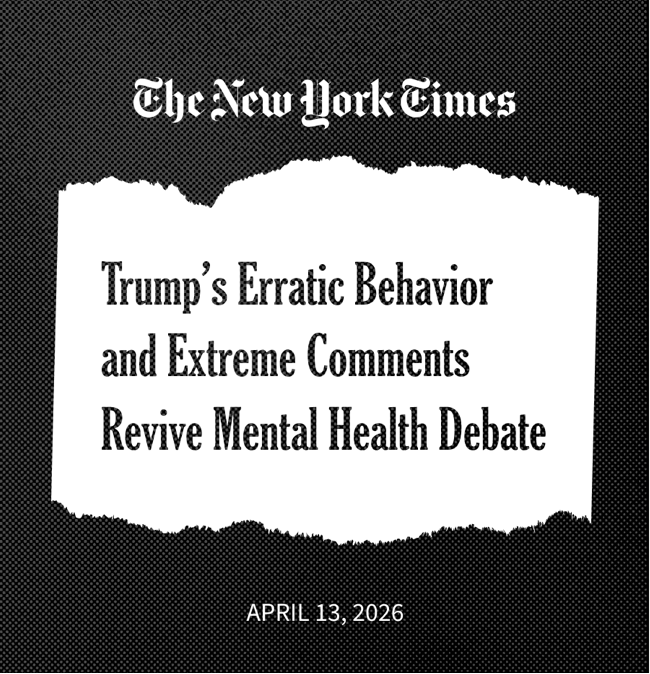
But because they despise Trump, a different standard applies. He is now judged to be bordering on, of all things, incompetency. Consider this recent gem of a headline from the Times below that exactly illustrates my point.

Parroting Democratic talking and stalking points, Trump is clearly insane to demand unconditional surrender and use harsh rhetoric against an enemy of the United States.
The conflict underscores to me the exact opposite. It instead highlights Trump’s sanity and common sense.
First, Iranian resolve in the face of total military defeat—I realize this is not the narrative the legacy news media spins, but it is the irrefutable truth nonetheless—is far greater than we in the West understand or appreciate.
If the Iranian leadership is willing to “claim” control of the Strait of Hormuz with their military nearly annihilated, imagine the demands they’d make if their regime ever had access to first-strike nuclear weapons?
Second, Iran’s ballistic missile program was far more advanced than Western intelligence understood before the conflict began. Two unarmed ballistic missiles that Iran fired reached Diego Garcia, the location of a joint U.S.-U.K. military base about 2,500 miles from Tehran in the Indian Ocean.
Significantly, the distance the missiles traveled was greater than to all potential targets in the Middle East as well as European capitals including Paris, Berlin, Rome and perhaps London, as the map below indicates.
I find that alarming. How about you? Hard to imagine why the French, Germans or Italians wouldn’t be equally concerned.

Returning to the subject of marriage—pronounced “mawage” by the Impressive Clergyman in this memorable clip from The Princess Bride—the Times’ worldview never wavers.
Whether it be reporting on the future of marriage, MAGA’s influence over our politics or predicting the calamitous impact of “climate change” and artificial intelligence, the Times’ fatalism is hard wired. Invariably and inevitably, whatever the subject—Covid, Trump’s election and presidency, the war with Iran, you name it—our demise is nigh.
The Washington Post, which proudly proclaims on its front-page masthead to be nothing less than democracy’s defender, unerringly hews to the same mindset.
The Post’s more accurate motto ought to be: “Depressed? Let us add to your misery.” No surprise that this doesn’t exactly appeal to readers. It recently laid off a third of its staff under orders of its jet-set owner and Amazon founder, billionaire Jeff Bezos.
Given such fatalistic world views, why wouldn’t marriage be less appealing than ever?
Marriage demands two virtues that are decidedly out of sync with our modern ethos. The first of these is sacrifice, the second hope. Hope is by its very definition bold and audacious.
Former President Barack Obama thought as much when he penned his political memoir in 2006, a book which gained him national attention and propelled him to the presidency. You may recall the title of his memoir: The Audacity of Hope. But that was eons ago.
Now, it’s the audacity of partisanship. In Virginia, the former President was an active cheerleader and spokesman for the gerrymandering measure voters there on Tuesday narrowly approved.
The redistricting of the state’s House seats in Congress will now increase from a slight 6-to-5 Democratic majority to a lopsided 10-to-1 (91%), even though 46% of the voters in the state cast ballots for Trump in 2024.
There is a different calculus in politics now. The end justifies the means. It’s the same doctrine that operates in the news media. The endgame is about winning at any and all costs.
Who can be hopeful amid such circumstances? Christians can and should be. Ours is a message of hope in a fallen world. Hope is the unconditional condition of any and all who dare to call themselves Christian (Romans 5:2). But just as optimism is infectious, so too is pessimism.
Without hope, why get married? For that matter, without hope, why have children? Why pursue a career or get a job? Why even get out of bed or emerge from your parents’ basement?
The proposition that the more you cling to secular humanism as your North Star the more forlorn you’ll be strikes me as the most pervasive but least understood and examined reality of modern times.
Three years before Donald Trump was born, the incomparable C.S. Lewis not only identified the ascent of secularism in public education but correctly predicted what the impact would be. Ironically, it was a prediction that came in an era when doomsdayism may have been justified, certainly more so than it is today.
In 1943, Hitler still ruled continental Europe. In 1943, the legendary battles that would defeat the Nazis were a glimmer in General Eisenhower’s eyes. Lewis, who was then the second most recognizable radio voice on the BBC behind only Winston Churchill’s, gave a lecture to educators titled “Men without Chests,” which solidified his place as Britain’s leading defender of the Christian faith.
Britain was producing “Men without Chests” in its educational system, Lewis then asserted, long before anyone else diagnosed the coming malady of modern education.
What he meant by that clever phrase was soulless human beings detached from their Creator, the source of all wisdom, beauty and virtue. Those so educated were without “those habits of the heart like courage that enable us to flourish,” says this online commentator.

Without a clear understanding of virtue, its origins and its proper instruction, education in Britain was effectively doomed, as were those so instructed, Lewis asserted.
“The operation of The Green Book and its kind is to produce what may be called Men without Chests,” he wrote. The Green Book was an English grade-school textbook in common circulation at that time which embraced relativistic educational approaches, discarding classical objective truth in favor of modern subjective feelings.
Lewis concluded his lecture and essay with a stirring warning—and prophetic portrait of the world we now occupy which hates masculinity in all forms: “We make Men without Chests and expect of them virtue and enterprise. We laugh at honor and are shocked to find traitors in our midst. We castrate and bid the geldings to be fruitful.”
Britain, though, paid little heed to Lewis’ critique. Hitler may have been defeated, but progressivism was on the march. Its foot soldiers have now made it the mandatory idol throughout Europe.
So much so that Britain is now in the process of jettisoning Churchill’s portrait from its currency. His replacement: it could be a squirrel as comically pointed out in a recent WSJ column. This is NOT a joke, though I wish it were.
“The Bulldog [Churchill’s nickname during World War II] is out of the Pound. Make way for the Squirrel,” the provocative but accurate headline read. “In the latest augur of Western decline, the Bank of England dumps national heroes in favor of animals.”
In Finland, meanwhile, it is now illegal to promote biblical views.
In a shocking ruling delivered in Helsinki several weeks ago, the Supreme Court of Finland by a 3-to-2 majority convicted a 66-year-old physician and longtime Christian Democratic parliamentarian of “hate speech.”
The Finnish lawmaker, Päivi Räsänen, and her Lutheran bishop, Juhana Pohjola, were convicted for having distributed a 22-year-old pamphlet which referred to homosexuality as a “developmental disorder.” The court ordered that the text be “removed from public access and destroyed.”
“What this means is that it is now illegal in Finland for Christians to defend traditional Christian teaching about homosexuality,” writes Christian Rod Dreher, a former journalist and the author of Live Not By Lies, in the Free Press. “You can’t write or speak about the matter without risking arrest. This, in Europe, in 2026.”
In the United States, we too have been edging toward outlawing Christian views, and certainly censoring Christian advocacy.
One stunning example of this was the report made public last week by the Justice Department. It details how the Justice Department under the former administration weaponized federal law against pro-life Americans.
Among the more stunning findings was that the Biden DOJ closely collaborated with pro-abortion groups to identify, prosecute and imprison dozens of pro-life advocates. The report is not easily dismissed as a partisan document (as the media will undoubtedly say it is) because it contains more than 800 pages of evidentiary exhibits!
In addition to the law, progressivism has been on the march in private and public education. Those who advocate progressive policies in education have used the law to advance their agenda as Supreme Court Justice Clarence Thomas points out in the video below.
I highly recommend you watch this video. You will not find a clearer statement of the battle that imperils our future than that which Justice Thomas delivers.
Drawing on his extensive tenure as a jurist and member of the Supreme Court for 35 years, Justice Thomas delivered his address at The University of Texas at Austin last week, reflecting on the continued relevance of the Declaration of Independence.
He starts his address by summarizing James Madison’s famous essay Federalist No. 10 written in 1787.
A Virginian who became our fourth President, Madison and others in the 85 essays contained in the Federalist Papers sought to persuade reluctant Constitutional Convention delegates to ratify the Constitution. He argued that the Constitution was necessary because of the fallen nature of man—an argument which should be familiar to anyone who attends Beverly Heights.
Because man is sinful and the desire for power was “sown in the nature of man,” Madison wrote in the Federalist No. 10, “government had to be limited.” The Constitution before them would provide those necessary limitations.
Madison advocated for constitutional governance as guided by the principles contained in the Declaration of Independence. It conceived of governance with a vertical orientation, with God conferring upon each individual inalienable rights. The rights of the governed, in other words, superseded those of the governors.
With his election in 1912, our 28th President Woodrow Wilson instead championed the progressive view, a horizontal orientation detached from God but brimming with governors whose direction derived from self-enlightenment.
Wilson and fellow progressives such as John Dewey (1859-1952), the father of progressivism in American education, attacked the Framers whose ideas, they thought, were anathema to modern, effective governance (who took their inspiration not from Madison but strangely from Bismarck’s running of Germany).
It is the fundamental and existential political confrontation of our age, Justice Thomas explained, between Madisonian originalists and Wilsonian progressives like Dewey who held “that our rights and our dignities come not from God, but from the government.”
“As we meet today,” Justice Thomas said eloquently, “it is unclear whether these principles [of freedom and liberty which derive from God and the natural rights of the individual over the government] will endure.”
It was a sobering, moving address. He continued: “Since Wilson’s presidency, progressivism has made many inroads in our system of government and way of life. It has coexisted uneasily with the principles of the Declaration. Because it is opposed to those principles, it is not possible for the two to coexist forever.”
It’s not much of a leap from the thesis Justice Thomas presented to a development of local note such as what happened in our own Mt. Lebanon School District.
Back in 2022, the district was sued by parents who challenged the mandatory program of subjecting first graders to transgender education. Because the alleged abuse had violated the Constitution, the suit was filed in Federal District Court.
That court ruled two years later against Lebo schools and in favor of parents who’d objected to the practice as an infringement of their religious rights under the First Amendment. Unlike Finland or Britain, we have a First Amendment which still provides very robust protections for religion and free speech.
Thanks to Madison and our Declaration and Constitution, the U.S. Supreme Court last June also halted the same practice of indoctrinating first graders in trans ideology when it ordered a stop to the practice in the public schools of Montgomery County, Maryland, the state’s most populous county.
In addition, the Supreme Court recently decided by a lopsided 8-to-1 margin to strike down a Colorado law that outlawed so-called “conversion therapy” in that state. The law, the Justices said, was a clear violation of the First Amendment’s freedom of speech protection.
The lone dissent in the decision was Clarence Thomas’ progressive adversary on the Court and the other black Justice, Katanji Brown Jackson. As the lone dissenter, even her two liberal colleagues on the Court also voted with the more conservative majority. You may recall that during Jackson’s confirmation hearing in 2022, she declined to define the difference between a male and female when questioned.
While the opposing orientations of the Court’s two black representatives may seem like a trivial matter, it underscores the far-reaching consequences of our culture wars. Thomas represents the Madison originalist perspective while Jackson is a devout Wilsonian progressive.
In response to the leftward drift in public education favoring the Wilsonian perspective, parents have been withdrawing their children from public schools on an unprecedented scale in recent years.
The number of U.S. children who are now educated outside the public system (cyber, homeschooling and private options) has doubled since Covid to about nine million school children nationwide. Consistent with this trend, at Beverly Heights we wisely started our own church Academy in 2022.
According to current forecasts, the number of U.S. children educated outside the public system is expected to more than double again to about 20 million students by 2030.
If that forecast holds—and with the lowest fertility rates on record yielding fewer children, it likely will—it’s quite possible that very soon as many kids will be educated outside the public system as within it.

As we close, let’s return to “Men without Chests.”
When Lewis delivered his lecture in 1943, there were more men with chests than perhaps Lewis then understood.
They swarmed the beaches of Normandy and the forests of Bastogne in 1944 as the chests of many were blown apart. Ultimately a coward, Hitler—the source of so much misery on planet Earth—took the coward’s way out. He retreated to his Berlin bunker to kill himself only a week before Germany surrendered in May of 1945.
Today, though the news media is reluctant to recognize valor let alone commend it, there are men with chests still.
Two truly heroic news events occurred in the past month, both of which illustrate this and merit fuller examination. The first of these events was the miraculous rescue of a downed airman behind enemy lines in Iran.
On Good Friday, April 3, two U.S. aviators were ejected out of the cockpit of an F-15E fighter jet that had come under enemy fire. The damaged plane crashed hundreds of miles inside Iranian territory.
Though the pilot was quickly rescued, the airman in the second seat was missing and feared dead.
For nearly two days, injured and alone, the U.S. aviator hid in a remote mountain crevice as Iranian forces and militias closed in on him with helicopters and drones. Despite his injuries, he had climbed to an elevation above 7,000 feet to evade capture.
It was the first time a piloted U.S. aircraft had been lost over enemy territory in more than 20 years.
After the Pentagon had established that the airman was still alive, and the CIA had determined his general whereabouts, President Trump gave approval to commence what had been described to him as a very risky rescue mission. The Pentagon then mounted a herculean effort to devise and execute the plan that ultimately extracted the Air Force colonel two days later, before Iranian forces got to him first.
Hundreds of Special Forces were deployed in the rescue mission along with the necessary military hardware. The CIA tracked him to a mountain crevice, which was described as finding a needle in a haystack.
Armed with only a handgun, the situation could hardly have been more desperate for the injured colonel. But after activating his transponder and sending the message “God is good,” he was extracted in a daring rescue on Easter Sunday. Many of the rescue details still have not been fully disclosed.
Among the news sources I consulted that day, only the Free Press reported what to me seemed the most obvious and accurate storyline under the circumstances. “An Easter miracle in Iran,” its headline read.
Other press outlets were fixated not on the miraculous recovery operation but the “controversy” which Secretary of War Pete Hegseth had supposedly stirred up but which in reality was fake news.
“Hegseth likens Easter rescue of U.S. airman to resurrection of Jesus Christ,” the Times thundered. Same old same old.
Similar bias against the spiritual stood out to me in the coverage of the second story of heroism, the Artemis II moon mission.

Describing the Artemis mission as heroic doesn’t quite do it justice.
On Friday evening, April 10, when the crew—Reid Wiseman, Victor Glover, Christina Koch, and Jeremy Hansen—splashed down in the Pacific Ocean off the coast of San Diego after their 10-day voyage, it felt as though the entire world had breathed a sigh of relief.
We were at a dinner party in the Bahamas at that moment, the last night of our vacation there. When the host announced that the heat shield had held and they had returned to Earth safely, everyone at the party broke into spontaneous applause.
“Crowds lined the beaches of California,” the Free Press reported. “Children on the East Coast stayed up late to watch the broadcast. Millions around the globe anticipated the safe return of four human beings—three Americans and one Canadian—who had ventured farther into space than anyone before them. It felt magical. It felt like a miracle.”
It reminded me of the space explorations of yesteryear.
The mission on Christmas Eve in 1968, when the crew of Apollo 8 took turns reading the first 10 verses from Genesis during lunar orbit, broadcasting to about one billion people. The moon landing seven months later in 1969 when Apollo 11 landed on the Moon for the first time and Neil Armstrong uttered his famous words before touching the lunar surface.
People felt proud to be Americans then, and I felt a similar shot of adrenaline this time.
I was later surprised to learn that one of the astronauts had read passages from Scripture aloud during their journey, shortly before entering a communications blackout behind the moon.
Artemis II pilot Victor Glover, a committed Christian and Sunday school teacher, also offered his reflections on faith during a space interview with CBS News.
“We need Jesus, whether on Earth or circling the moon,” he said.
How had I missed this? I missed it because a subsequent review of the coverage showed that it received scant coverage, so perhaps you may have missed it too. CBS, Fox and the Free Press covered it. So did the UK Daily Mail of Britain. Otherwise, nada among major news outlets.
Something else happened in a spiritual vein on the mission that was generally overlooked.
After splashdown and safely aboard the ship that was transporting the team back to dry land, Commander Reid Wiseman asked to see the ship’s chaplain—and broke down at the sight of his cross.
“I’m not really a religious person, but there was just no other avenue for me to explain anything or to experience anything, so I just asked for the Navy chaplain to come visit us for a minute,” Wiseman shared.
“When that man walked in—I’d never met him before in my life, but I saw the cross on his collar, and I just broke down in tears,” Wiseman said during the NASA press conference in Houston. “It’s very hard to fully grasp what we just went through.”
His worldview had been literally altered by glimpsing the Sun, the Moon, the Stars, and planet Earth, in a way few humans ever experience. He’d encountered the numinous, and it changed him.
That’s my report for April. May you too encounter the numinous in the month ahead. In the meantime, blessings to you and yours.

