
Tuesday, January 6, 2026
Good morning.
Happy New Year! Welcome back to O’Bservations.
My mission in preparing this monthly newsletter remains the same as it has always been: to be in the world (as your dutiful news reader) but not of it, as Scripture commands.
That mission seems like mission impossible many times. In fact, truth be told, I opted not to write in December because I needed an Advent break from writing about the news (though I did not stop reading it).
I got a shot of adrenaline, though, from the video below, which gifted me with the subject for today’s report.
That subject is character. Or more specifically, the lack thereof in modern times. That’s what stood out to me most forcefully over the seven weeks since I last wrote. With a big tip of my three-cornered hat to George Washington—at least the artificial version of him.
The speaker in the video is the prodigiously creative Glenn Beck, who owns the Blaze network.
Beck has been a fixture in conservative media circles for a long time, all the way back to the heyday of the late Rush Limbaugh. Long before anyone ever heard of Tucker Carlson or Ben Shapiro, there was Rush and Beck. They were trailblazers in a field now overflowing with conspiracists, antisemites, Hitler fan boys, and grifters of one kind or another.
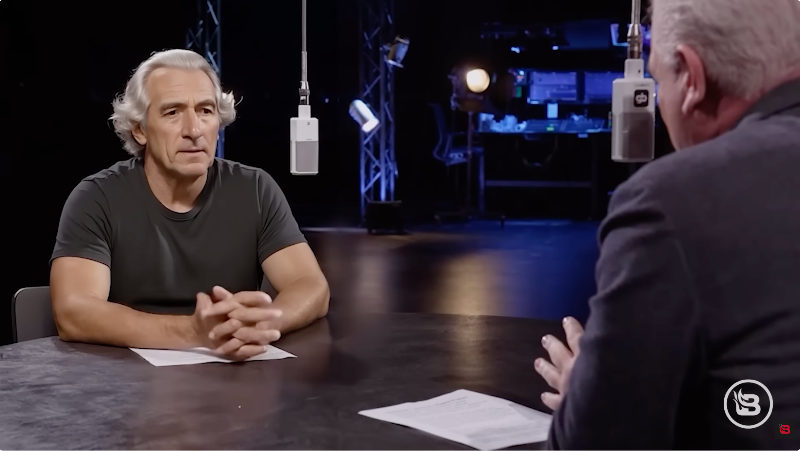
Beck’s latest venture is what he calls “George AI,” shorthand for an artificially generated George Washington. If you move forward to minute 5:53 of the video, you’ll see Beck interviewing our first President and first among all Founding Fathers, Mr. Washington.
The “interview”—which runs about 2 minutes, embedded in the longer 15-minute segment above—is a prelude to the release this month of “George AI,” which Beck and his associates at Blaze built.
This comes against the backdrop of much recent conversation about the morality and utility of artificial intelligence.
Depending on who you listen to, AI will either end civilization as we know it or usher in a giant leap for mankind. Already, lawsuits allege that one AI platform (ChatGPT) has inflicted great harm to humans, coaching some depressed users into delusion and suicide.
While I understand the threats that a technology as powerful as AI may pose, I also see enormous advantages for our betterment. As with any new technology, it seems to me the problem is not AI itself but the character (or lack thereof) of its creators and users.
Sin is a pervasive human condition. It existed among biblical patriarchs and the Founders of this country. As much as we may desire to look at the past through rose-colored glasses, the pervasiveness of sin has been with us ever since the Fall. Technology merely facilitates sin in new and potentially harmful ways.
“George AI” seems to offer limitless educational opportunities. I learned the same about artificial intelligence last month when I took my first plunge using it to build a cartoon illustrated, voiceover history lesson for the class I teach in our church Academy.
Any AI program is only as useful (or harmful) as the information fed into it. In the case of “George AI,” the inputs are indeed prodigious.
In the video, Beck explains that it is based on the largest library of Founding Father documents in the world, gathered together for this specific educational purpose. Only the National Archives and the Library of Congress in Washington have a larger repository, Beck claims.
In addition to contemporary data and the Founders’ writings—as well as the books that influenced them—it also has loaded into the database sermons they heard from the preachers of that time. It is, therefore, a time machine of sorts, transporting users back some 250 years and permitting the time traveler to receive ancient moral reasoning that previously came to us only via history texts.
Mr. Washington conveys character that, needless to say, is decidedly out of fashion in modern times.
Hence, his analysis of the problems we face as a country is fascinating and incisive. You also can’t help but chuckle at the sight of the father of our country with curly gray hair, bulging biceps and wearing a slim-cut slate-gray tee, as seen in the screenshot below.

Almost as if on cue, the blogosphere immediately mocked the interview as a “great example of the immense uselessness of AI for anything.”
That’s because the message Mr. Washington delivers is conservative in tone and substance, reflecting his 18th century sensibilities. The internet these days is nothing if not reflexively disdainful of conservative values and opinions. But it was hardly useless.
“If I’m honest, America’s biggest problem isn’t political or economic, it’s all moral,” the imaginary President Washington tells Beck. “You’ve drifted from the virtues that make liberty possible in the first place: freedom. To be free, you have to have discipline, you have to have faith, you have to have character.”
President Washington continues with a very cogent dissection of our collective problem a quarter of a millennium since the Declaration of Independence, this year marking the 250th anniversary of that document on July 4. I’ve been offering snippets of American history in this space since September to celebrate this momentous milestone, and I’ll conclude this issue with a vignette of the same.
Here is George’s summation of our collective problems, from Mr. Beck’s “interview” with him.
“You have grown skeptical of truth,” George says, accurately evaluating prevalent attitudes toward religious faith. The precipitous decline in religion in this century is irrefutable evidence of his point.
“You’re reckless with debt,” George says. This point also is irrefutable as federal public government debt has skyrocketed from $5.6 trillion at the start of this century to over $38 trillion now.
George continues: “You’re comfortable blaming instead of building anything. And in my time, we understood that self-governance begins with self-control. Do you even recognize what self-control is?”
Point well taken.
He then offers: “Public virtue matters more than public opinion. You keep electing these people expecting things to change but you haven’t changed. The fix is not going to be found in Washington, D.C. It’s going to be found in every home, every school, every heart.”
Check.
He further asserts: “Where are the citizens who value duty over comfort? Principle over popularity? America was built to be a moral and self-governing nation. It’s only that foundation that will still save her.”
All of the above seems impossible to refute.
As I’ve asserted many, many times in this column in its nearly six years of existence, America is unique in the history of modern civilization. According to the mantra that emanates from elites on the progressive Left, and spread widely like a virus, we are indeed unique: uniquely racist, uniquely evil, uniquely unjust.
Many of our once most respected institutions—public schools, universities, the news media, the Church (sadly, even the Protestant variety)—embrace the cultural malfeasance that this view represents, without regard for its larger consequences.
President Trump’s war against the Diversity, Equity and Inclusion (DEI) agenda and bandwagon is a bold attempt (and hugely successful so far) to reverse this trend, which has been decades in the making and hit its apex during the Obama and Biden presidencies.
Even the most cursory reading of American history refutes the DEI mind virus. It is also irrefutable that throughout our national history, freedom and faith have been the dual pillars of “American exceptionalism,” with character (and virtue) being the third crucial pillar that supports the others.
The Washington interview underscores why we were unique, and how we will not continue to be if we fail to heed his advice. The perils before us in maintaining “American exceptionalism” are as plainly evident as the prominence of President Washington’s AI-generated nose.
The Founding Fathers argued that the success of America’s democratic experiment depended on the character of both its leaders and its people. “The destiny of the republican model of government,” Washington declared in his First Inaugural Address in 1789, hinged on Americans practicing a high level of both private and public morality.
Nor was this sentiment a uniquely American proposition. In Plato’s Republic, character is the most important qualification of the ruling class. In the Old Testament, Israel prospered under kings with godly character—and failed under kings with deplorable character.
My own personal favorite President—Teddy Roosevelt—told the American Bible Society in 1916 that he believed the fate of the American republic rested “on the moral character and educated judgment of the individual.”
Teddy’s prediction perfectly captures the societal dilemma of modern times. Things like duty, honor, faith, character—the moral code TR and George lived by—are not valued to the extent they once were. That seems irrefutable to me.
Unless Americans lived “in accordance with the laws of the highest morality,” President Roosevelt warned in his 1906 Thanksgiving proclamation, the nation’s unprecedented prosperity in the long run would be a “curse instead of a blessing.” Abundant prosperity, he warned, would not save America if its spiritual senses atrophied.
There indeed seems to be a direct correlation between the decline in our collective moral character and the larger national decline we’ve experienced over the last quarter of a century.
Whether you are liberal or conservative, it’s again irrefutable that the first quarter of the 21st century—which ended last week—has been a period of misgovernment, cultural malfeasance and national decline on a scale we’ve never before witnessed for such a sustained time in our 250 years of existence.
If you doubt that character and its deformation is the chief problem Americans face in 21st century America, as “George AI” maintains, I submit for your consideration some headlines from the last seven weeks. They provide ample evidence in support of George’s contentions.

In the category of misgovernment and turning a blind eye to widespread fraud, it’s hard to top the ever-widening scandal in Minnesota involving Somali immigrants there.
You know that a story has broken “containment” when media sources that desperately want to ignore it are suddenly compelled to report on it. I define media “containment” as the practice—now standard in the mainstream news media—to ignore inconvenient facts or stories. That is, stories which challenge their liberal orthodoxy.
Examples would be: Hunter Biden’s laptop did not exist; Trump (in his first term) engaged in a vast conspiracy with Russia to secure the presidency; the Covid virus had natural origins; Joe Biden was fully functioning when he was President. Et cetera, et cetera, et cetera.
When reporters are ruled by this sort of mind virus, they think they can “contain” that which they ignore. But in late November, the Somali story broke containment when the New York Times actually reported on it.
They did this because it had grown too large to ignore. That’s how enormous this Somali scam is. And worse still, it goes to the heart of two subjects they also wish to suppress the truth about: immigration and DEI.
The fraud—which wags have dubbed “Minnesota Vice” and the “Somali Pirates of Minneapolis”—centers on false claims made by fictitious social-service providers. It’s been investigated for many years under both Trump and Biden Justice departments.
But as usual, the watchdog, i.e., the liberal Minnesota news media, was asleep. The scandal was virtually ignored until late November when the conservative City Journal in New York reported that millions of dollars in stolen funds were sent to Somalia, “where they ultimately landed in the hands of the terror group Al-Shabaab.”
That’s the same Al-Shabaab which the Pentagon has targeted with airstrikes to combat the terrorist organization’s slaughter of Christians across the African continent.
Federal investigators have already charged and convicted about 60 defendants—most of Somali descent—in criminal cases brought against them.
Another 40 or so Somalis have so far been charged in what prosecutors have described as the nation’s largest Covid-era scheme to defraud taxpayers and the federal government. The cases, brought by the U.S. attorney in Minnesota, are part of Justice Department efforts to uncover theft from federal assistance programs, which burgeoned during Covid.
Scammers created fictitious social services as the conduit for their theft. The services included fraudulent meal and housing programs, daycare centers, and Medicaid services.
The fraud losses—money stolen from the federal government through illicit reimbursement claims for the social services supposedly provided—are said by prosecutors to exceed $9 billion since 2018. For perspective, that sum nears the entire country of Somalia’s gross economic output for a year.
Among other activities, the schemes promised to fund meals for children during Covid, using federal dollars. The perpetrators set up fake meal sites, created false lists of kids, and sent oceans of reimbursement bills to the state. Reimbursement money was used to pay for cars, houses, trips, and other luxuries, according to federal prosecutors.
“Some Minnesota state employees had begun to smell something fishy even before the U.S. attorney’s office became involved,” the Free Press reports, explaining the early evolution of the scandal.
“They started to delay reimbursements to examine potential fraud. But the scammers played the race card, threatening to sue the state for discrimination if the payments were delayed. Protests erupted. State officials backed down.”
The scammers were emboldened by support from Governor Tim Walz (yes, that Tim Walz, Kamala Harris’ running mate on the 2024 Democratic presidential ticket) and his Attorney General Keith Ellison, who according to the Free Press wrote in one email: “Walz agrees with me that this piddly, stupid stuff running small people out of business is terrible.”
The alleged crooks were not terrible, mind you, but the investigators looking into “this piddly, stupid stuff.”
So much for state oversight.
With investigators sidelined and reporters asleep at the switch, an outraged public has come to rely on a young, independent and enterprising YouTuber named Nick Shirley, who did what the local news media should have done long ago.
He went knocking on “day care” centers door to door—the actual recipients of federal funds, mostly run by members of the Somali community—and found that dozens of the places that claimed to provide services were either closed or missing children.
Shirley posted to YouTube the 42-minute video investigation last week (below), and it went enormously viral, with some 134 million views on X alone.
And the news media’s response to Mr. Shirley’s enterprise? He has been designated a “right-wing influencer,” and therefore persona non grata. The truth of what he revealed didn’t matter.
Here’s CNN, which sought to discredit him. MS NOW attributed coverage of the scandal to the “politization of the [Department of Justice] and the FBI” under President Trump, and said the Somali community was being “scapegoated in a way that certainly serves the far Right.”
Minneapolis’ two local newspapers—the Star Tribune and Pioneer Press, once distinguished news journals—didn’t bother to cover this new development of intense local interest.
And the national news media? It focused attention on the Trump administration freezing child care funds to Minnesota due to the scandal. This video from AP quotes the Somali director of ABC Learning Center in Minneapolis who claims: “The viral video alleging fraud by right-wing influencer Nick Shirley is part of a political campaign against Somali Minnesotans.”
I am not trying to pick on Somali immigrants in my long recitation of the scandal. If they emigrated to America legally, they are welcome. But they also need to obey the law in this country, as would any citizen. Theft is theft, and cannot be rationalized or excused based on race.
Meanwhile, Somali Congresswoman Ilhan Omar, a Democrat who represents the Somali district in Minneapolis, went from being nearly broke to net worth of as much as $30 million in one year, the conservative New York Post reports, citing recent required financial disclosures.
Minnesotans have long prided their state for its “good governance,” as well as the generosity of its social services. Minneapolis became a hub for Somali emigration for that very reason.
So far, Governor Walz has rejected bipartisan demands to resign.
At a press conference on Monday, Walz said he no longer plans to seek an unprecedented third-term as Minnesota governor this November, as had been his intention previously. We’ll see if his refusal to step down holds, as investigators examine his involvement in the scandal.
In the meantime, I find great contrast between the lack of character Walz has displayed, and the great character former Nebraska Senator Ben Sasse exhibited last month.
Mr. Sasse resigned from the Senate in 2023, having served eight years, to become president of the University of Florida. Once discussed as a possible GOP presidential contender, the 53-year-old revealed before Christmas that he has advanced pancreatic cancer and expects to die soon.
He posted a moving letter on X, which was republished in the WSJ. Below are excerpts from it.
Advanced pancreatic [cancer] is nasty stuff; it’s a death sentence. But I already had a death sentence before last week—we all do. …
As a Christian, the weeks running up to Christmas are a time to orient our hearts toward the hope of what’s to come.
Not an abstract hope in fanciful human goodness; not hope in vague Hallmark-sappy spirituality; not a bootstrapped hope in our own strength (what foolishness is the evaporating-muscle I once prided myself in). …
A well-lived life demands more reality—stiffer stuff. That’s why, during Advent, even while still walking in darkness, we shout our hope … we hope in a real Deliverer—a rescuing God, born at a real time, in a real place. But the eternal city—with foundations and without cancer—is not yet. …
I’ll have more to say. I’m not going down without a fight. … But for now, as our family faces the reality of treatments, but more importantly as we celebrate Christmas, we wish you peace: “The people walking in darkness have seen a great light; on those living in the land of deep darkness a light has dawned … For to us a son is given” (Isaiah 9).
Friends, this is what true Christian character looks like and sounds like, even when facing imminent death.

I’d also like to give a shout-out to Bari Weiss for the character she has displayed in her efforts to restore rigorous news standards to CBS News.
You may recall that Weiss, who was born and raised in Pittsburgh, in October was named Editor in Chief of CBS News by Paramount, which owns CBS.
At that time, Weiss said she and Paramount CEO David Ellison were aligned in their desire for “news that reflects reality” and journalism that “doesn’t seek to demonize, but seeks to understand.”
Both are much needed, laudable goals.
Paramount also bought Weiss’ fledgling news startup, the Free Press, which continues to post phenomenal growth. The Free Press yesterday announced the addition of several new contributors, including conservative Christian Rod Dreher and conservative Abigail Shirer, who exposed the truth about gender-affirming care long before these evils were on anyone’s radar.
Weiss had a busy month in December challenging current news practices at the once storied CBS News network. Before Christmas, she pulled a 60 Minutes segment on an El Salvador maximum-security prison where the Trump administration sent hundreds of Venezuelan migrants.
The report was held “because it wasn’t ready,” she said in a memo to the CBS News staff. Her decision to hold public release of a segment that had already been promoted—in defiance of the howling masses within CBS News—took guts.
“Right now, the majority of Americans say they do not trust the press. It isn’t because they’re crazy,” Weiss wrote in the memo, defending her decision.
Is it any surprise that she hails from Pittsburgh?
“To win back their trust, we have to work hard. Sometimes that means doing more legwork. Sometimes it means telling unexpected stories. Sometimes it means training our attention on topics that have been overlooked or misconstrued,” she continued. “And sometimes it means holding a piece about an important subject to make sure it is comprehensive and fair.”
All irrefutable points.
Holding a story because “it isn’t ready” is a fairly routine act of any legitimate editor in any legitimate newsroom. I did it many times when I was a news editor. Weiss even provided the contact information in the White House of the people she wanted the reporter, Sharyn Alfonsi, to contact.
Predictably, she and 60 Minutes colleagues had a public meltdown over this alleged act of capitulation to the Trump administration.
60 Minutes correspondent Scott Pelley said: “She needs to take her job a little bit more seriously.” Alfonsi said: “If the standard for airing a story becomes ‘the government must agree to be interviewed,’ then the government effectively gains control over the 60 Minutes broadcast. We go from an investigative powerhouse to a stenographer for the state.”
Pleeeeease! Do your job!
Your job as journalists is not to avoid asking questions, out of fear that the answers may not align with your version of the truth. Your job is to get the best obtainable version of the truth, without fear or favor.
Call the balls and strikes fairly, in other words, not as you wish them to be.
Their outburst prompted this clever and spot-on response from the Babylon Bee: “Scandal rocks CBS News as Bari Weiss asks journalists to do journalism.”

The second example of character that Weiss displayed in December was shown to viewers who tuned in to watch CBS News Presents: A Town Hall with Erika Kirk.
It was the first network news interview with the widow of Charlie Kirk, whose brutal murder on September 10 horrified me and much of the Christian world (not all, as some Christians justified his murder, including some in our former Evangelical Presbyterian denomination).
Weiss accepted pre-arranged questions from the audience in the town hall format.
The second questioner was Hunter Kozak who had witnessed Kirk’s murder in Utah. After expressing condolences to Erika, Kozak launched into a lengthy recitation of President Trump’s public comments which he contended incited political violence.
He then asked: “Will you condemn the violent rhetoric of Donald Trump, the most powerful and influential person on Earth?”
“I understand your sentiment, I do. But this [subject of political violence] is also so much deeper than one person. … You can choose to have evil in your heart or you can choose to have light,” she said, adding: “What I am trying to say here is we can blame everyone else.”
Weiss then interjected: “Do you think our political leaders have a responsibility to turn the temperature down right now?”
“Everyone has a responsibility to do that,” Erika replied, “and I’m doing my part. I’m not in control of other people.”
I liked her response. It reminded me of what C.S. Lewis says about character development and the role it plays in Christian formation. In Mere Christianity, Lewis posits that each person is the guardian of his or her own character formation (or deformation, depending on the choices made), which determines one’s eternal destiny.
“Every time you make a choice you are turning the central part of you, the part of you that chooses,” Lewis writes, “into something a little different than it was before. And taking your life as a whole, with all your innumerable choices all your life long, you are slowly turning this central thing into a heavenly creature or a hellish creature.”
Amen.

Painted in 1865 by Constantino Brumidi, the fresco is suspended 180 feet above the Rotunda floor of the U.S. Capitol Building in Washington, D.C. It covers an area of 4,664 square feet. Shown is the detail of the image of George Washington as he ascends into heaven.
There can be no doubt that George Washington chose to transform himself into a heavenly creature.
Whether he was as heavenly as he is popularly portrayed—such as in The Apotheosis of Washington shown above—is debatable.
It is doubtful that as a boy, Washington refused to tell a lie about having cut down a cherry tree. He most probably did not kneel in prayer in the snow at Valley Forge during the winter of 1777-78 when the American cause seemed desperate, as famously depicted in a postage stamp and many paintings. And yes, he owned slaves (though he was the only Founding Father to free them upon his death).
Nevertheless, historians agree that Washington’s character was the greatest of his attributes, and why he is revered today.
One such historian is Gary Scott Smith, the retired chairman of the history department at Grove City College (and past podcast guest of ours) whose book, Faith and the Presidency, I reviewed when it was published in 2006.
Smith writes: “His character helped sustain his troops throughout the travails of the Revolutionary War, convince delegates to the Constitutional Convention to assign significant powers to the presidency, secure the ratification of the Constitution, and enable the new republic to survive in a hostile world.”
The greatest displays of his character came in what he didn’t do. Not once but twice he didn’t claim the power of a king when the United States was in its infancy.
First, as General Washington, he resigned his military commission at the end of the war to return to life as a civilian farmer at Mount Vernon. And second, as President Washington at the end of his second term, he refused to seek a third term.
Perhaps the greatest story of his character was described by the man whom he had defeated in the American Revolution.
As the war was drawing to a close, King George III famously asked his American painter, Benjamin West, what Washington would do after winning independence. West replied, “They say he will return to his farm.”
“If he does that,” the incredulous monarch said, “he will be the greatest man in the world.”
Friends, one of the things I try to bring to these reports is perspective and context, as an antidote to how the news is treated in our quick-draw culture.
This report has been historical in nature for that very reason. I’ll have more to say about the situation in Venezuela next month as the dust settles and we all gain more perspective on what it means, as I review the first year of President Trump’s return to office.
That’s my report for January 2026. Only six months to go until America’s 250th birthday. Until then, may you have a deeper appreciation for the faith and freedom we enjoy in this great land of ours. God bless.