

Wednesday, October 25, 2023
Good morning.
That we live in fragile and unstable times has been self-evident to me since the earliest dark days of the worldwide epidemic called Covid, way back in my first O’Bservations report in March of 2020.
Though Covid has largely ended, the instability of our times hasn’t. It is one of the great ironies of modern times that as we supposedly progress, our societal fragility and instability only seem to intensify.
We see instability in our schools, where the parents of children struggling with gender dysphoria are told by school districts that they have no rights to control care for their children or even the names by which they are addressed. In our own Mt. Lebanon School District here, we see a district seeking to supersede parental authority in educating first-graders on gender transition. This federal lawsuit against the district for doing exactly that is expected to go to trial in the second half of 2024.
We see instability on our streets, as violent crime surges in the nation’s capital. Washington has seen a 38% spike in homicides this year, the Wall Street Journal reports, upending life for residents and businesses. Robberies are up 70% in the district while car thefts have more than doubled.
We see instability and despondency in our homes, as suicide skyrockets in the United States. Nearly 50,000 Americans killed themselves in 2022, the federal government recently reported – the highest number on record. Incredibly, that’s one suicide nationwide every 10 minutes.
We see instability in our government, where the office of Speaker of the U.S. House of Representatives is vacant for the first time in our history. Earlier this month, a gang of eight Republican dissidents ousted the former Speaker from their own party, Kevin McCarthy. No Republican candidate has yet managed to get the necessary 217-vote majority to become the new Speaker.
We sadly see great instability in world events, too, such as the barbaric attack that Hamas terrorists unleashed on Israel earlier this month. The 10/7 attack was immediately called Israel’s 9/11. It was the largest single-day slaughter of Jews since the Holocaust.

The conflict began in the early morning hours of Saturday, Oct. 7, when Hamas terrorists crossed into Israel. They then proceeded to methodically slaughter innocents, rape women and take captives – including toddlers who remain in Hamas custody.
At an overnight music festival, Hamas paragliders murdered hundreds of unarmed young people in cold blood or mowed them down as they ran screaming. They murdered whole families as they begged for mercy. They burned people alive. They decapitated babies. They killed a grandmother and uploaded pictures of her corpse to her Facebook page. They cut an unborn child from a mother’s body and murdered both.
In addition to killing some 1,400 people – including 30 U.S. citizens – Hamas also kidnapped at least 200 Israeli and foreign nationals, bringing them to Gaza as hostages (several of whom have since been released). President Biden condemned the attack as “an act of sheer evil” and has pledged support for Israel, our longtime ally in the Middle East.
Israel responded to the kidnappings and killings with a declaration of war. Israeli counterstrikes in Gaza, where Hamas is headquartered, have claimed thousands more lives as its military levels Hamas strongholds before commencing a ground invasion.
Then, last week, the terrorists accidentally exploded a rocket in their own Gaza parking lot adjacent to a hospital.
Here is the news media spin which ensued immediately afterward, according to former New York Times reporter Nellie Bowles in her weekly TGIF news blog (which has become must reading for me these past few years).
Nellie writes: “As soon as [the rocket] went off, Hamas blamed Israel, which in turn said it needed a minute to verify what happened. Do you know who doesn’t need a minute? The mainstream American press.”
Nellie continues: “Reuters, The Washington Post and The New York Times blindly ran with the Hamas account: an Israeli strike, a hospital, hundreds of deaths – 500, according to the Times. (A collection of those headlines can be found here.) The Times even ran an image of a blown-up building – but it wasn’t the hospital. The news ricocheted around the world, to attacks on synagogues and marches on embassies. It is the dominant narrative now and likely forever. Even though it is a lie. In the information war, this was a spectacular win for Hamas.”
And Nellie continues: “After Biden announced that U.S. intelligence confirmed the Israeli government account – it was a failed rocket from within Gaza – there were no apologies, no corrections, just subtle headline changes to make it slightly factual-ish. … This is the week I realized that the adults I thought were flawed but trying are actually on meth and don’t care. Or maybe it’s even worse: they know it’s a lie.”
Welcome to the club, Nellie. Any confidence I once had in the mainstream news media was eviscerated during Covid.
As shocking as the Hamas carnage was, also shocking is how “progressive” groups around our country treated it.
Students at many elite universities – and some university professors, even at Harvard Divinity School – celebrated Hamas and what it had done.
Or consider this second item from the same weekly TGIF report (for the week before ending Oct. 13), which took my breath away:
Nellie wrote: “After Hamas paragliders landed in a music festival in southern Israel and slaughtered hundreds of unarmed Jewish youth, the leaders of Black Lives Matter Chicago and various leftist groups knew just what to do. They turned the image of the paratrooper against the sky – captured on video by those Jewish youth in a panic before their slaughter – into a chic black and white logo.”
The logo is below. How could anyone think it was acceptable to use this image of slaughtering Jews as a new and effective BLM brand?

Amid the moral depravity of the terrorists and moral rot of their defenders, many Jews and Christians seek refuge in their faith.
While that is often the case amid times of great instability, we should have that posture all of the time, for the Bible tells us that God is the only source of true stability in the universe. The Lord “will be the stability of your times,” Isaiah 33:6 reminds us. Only God provides the peace and security we yearn for.
Instability in the world should not shake us. Our assurance of stability emanates from outside this world, from its Creator. It comes from the knowledge that Christ died for our sins and He will return again to reign forever.
At the same time, we also sadly see instability in His Church. For the rest of this report, I’d like to focus on recent events which have engulfed Beverly Heights Presbyterian Church. I do this to convey understanding to you, the reader.
My perspectives are flawed, as I am a sinner and subject to the same frailty and error all humans labor under. But I conduct this inquiry in an honest and sincere attempt to explain what has transpired and to provide clarity, which has been lacking amid our schism of the past year.
As many of you are by now aware, Senior Pastor Nate Devlin resigned as the eighth pastor in the 94-year history of Beverly Heights, effective after the worship service on Oct. 15.
He did this when it became increasingly clear that our Presbytery of the Alleghenies, which had appointed an Administrative Commission on Aug. 1 to restore peace and unity to our body, was moving to force us to conform to EPC values that do not align with biblical leadership.
This was not a physical takeover, as we own our property. But it was a clear attempt to mold Nate into a pastor more in line with the pastoral template espoused by the Evangelical Presbyterian Church (EPC) and, at the same time, weaken the authority of our governing body, the Session.

The events which culminated in Pastor Nate’s resignation were a long time in coming. The earliest seeds were planted way back in 2007 when our congregation voted to depart from our predecessor denomination, the Presbyterian Church (USA).
While the vote then was overwhelming to leave (195-to-4), we were required as part of the process to designate the denomination to which we were departing. We chose (along with many other local congregations then leaving the PCUSA) to join what seemed like a good fit then, the EPC. The influx of PCUSA churches in Western Pennsylvania to the EPC was so great that an entire new Presbytery of the Alleghenies (POA) had to be formed to accommodate those departing from the mothership.
Headquartered in Orlando, Florida, the EPC has as its motto on the homepage of its website, “In Essentials, UNITY. In Non-Essentials, LIBERTY. In all things, CHARITY.” But as the EPC has grown to number more than 600 churches nationwide with about 145,000 members, some contend it has lost its way.
Among its critics are former Senior Pastor Devlin. In his 2,674-word letter to our congregation sent on Oct. 9, which revealed his intention to resign, he explained why “I am not an EPC pastor.”
“On Saturday, September 16th,” Devlin’s letter explains, “the [Administrative Commission] made a public admonishment without a guilty verdict [my bold added] and distributed their report to the full presbytery when an executive summary could have been filed in the minutes and the full report shared privately.”
His letter continued: “The public dissemination of the report, in the absence of context, cast serious doubt on my character. The report suggests that I am an alcoholic when I am not, and offers no evidence of biblical or moral wrongdoing, yet their report mandates that I publicly repent and abstain from alcohol for a year. To state this in public among my fellow presbyters severely injures my professional reputation and prohibits me from being an effective presbyter in the POA. The report has been and continues to be widely disseminated by some, to the congregation, and the larger community with ongoing negative consequences.”
His letter continued: “The AC’s report [which was attached to his letter, to make redundant further dissemination by his accusers] has clarified for me that, even though I continue to affirm without exception the Scriptures, the Westminster standards, and the EPC essentials of the faith, I have transgressed a culture and set of norms that are assumed, implicit, and expected in the EPC. The EPC motto is ‘In essentials unity, in non-essentials liberty, in all things charity.’ What I’ve discovered is that liberties are curtailed and charity withheld when these norms are transgressed and when modern evangelical culture is not sufficiently affirmed.”
Myself and Ruling Elders Dean Marshall and Todd Loizes were present at the lovely Bethel Presbyterian Church in Enon Valley, Pa., where the POA meeting was held that Saturday morning, Sept. 16. Pastor Nate, Peter Chace and Kyle Bennett were also present.
We were among more than 100 presbyters and observers when the five members of the Administrative Commission read aloud their four-page report. The accusers from our own congregation who had brought us to this day of reckoning, as well as their wives and supporters, sat in a group of about a dozen on the other side of the sanctuary.
Nate was seated to my left. Peter Chace, who since Nate’s resignation has assumed some of his duties, was seated to my right.
Peter is a “candidate under care,” pursuing ordination in the EPC while obtaining his Master of Divinity degree. To Peter’s right was Dr. Kyle Bennett, who was about to embark as a “candidate under care” (he already holds academic credentials sufficient for ordination).
I say “was” in Kyle’s case because the events of that morning were so shocking and demonstrated such a lack of care toward Nate that Kyle has since paused his ordination candidacy.
I’m still not over the shock of what happened, and I doubt Kyle or anyone else present from our group is either. We were in an ecclesiastical setting. Hence, there are certain expectations as to what constitutes appropriate conduct. The public reading of the report was, in my opinion, so inappropriate that I could scarcely believe what I was hearing.
There had been no judicial proceeding whatsoever. In fact, at the Aug. 1 meeting the POA had dismissed the charges brought against Nate by his accusers. The commissioners provided no advance warning of what was about to occur. In 45 years of covering events and countless meetings as a journalist, without doubt it was among the most shocking events I have ever witnessed.
You could have heard a pin drop while the five commissioners read from the report. You, the members of Beverly Heights, will likely hear the same report read aloud by the same commissioners when they come to our sanctuary this Sunday, Oct. 29. You may judge for yourself the accuracy and propriety of what you hear.
As the report was being read that first time on Sept. 16, I recall thinking, “This one event will change everything at our church.”
And alas, in less than a month after its public dissemination, it has. The AC said this process was intended to promote peace and unity, but it has done anything but.

Since the report was read, Nate has resigned. And after carefully and prayerfully weighing its options, Session notified the congregation later the same day when Nate announced his resignation, that it had voted unanimously to seek dismissal from the EPC.
“As you may be aware,” Clerk of Session Andy Lucas wrote, “we have been working with the POA since February in hopes of resolving some of the division and hurt that has occurred within our body. This process has had several stages including conversations with the Ministerial Committee and the formation of a Judicial Investigative Committee, a Mediation Committee, and lastly, an Administrative Commission. In all our interactions we have cooperated in good faith and in transparency with the Presbytery. … After hours of deliberation and days of prayer, Session believes that the report issued by the AC and the process undertaken by the POA were unjust.”
Having been present in many of those hours of deliberation, I concur absolutely and unequivocally with that judgment. In seeking dismissal, your Session not only made the right call but exercised the only option available to it under the circumstances, in my opinion.
Staying in the EPC was simply not an option. Certainly not for me nor, I suspect, many others in the leadership of this church.
While the path chosen is not without turmoil, it is, in Session’s judgment, the fairest option, which is to permit each voting member to decide whether to withdraw from or remain in the EPC. Members will be asked to cast their ballots on that question, most likely sometime in February of 2024. A two-thirds majority of the voting members of the congregation is required to withdraw from the denomination.
Andy’s letter continued: “As we have worked closely with the POA and the EPC over this past year, it has become increasingly apparent that our church is misaligned with the EPC as a denomination. There are core disagreements between our church and the POA about how a local church should function and operate. In short, the POA has made it clear that the church the Lord has been building for the past several years is not compatible with the EPC.”
What are these irreconcilable differences? In our Adult Christian Education class two Sundays ago, Elder Chad Winkler gave an overview of the differences.
What were once non-essentials in the EPC have now been elevated to essentials, Chad said.
The “liberty” which was once extended to non-essentials is gone, he explained.
For example, drinking in your own home? If malicious gossip spreads that you drink alcohol excessively, that’s apparently now deemed an essential. If congregants lodge a formal complaint about it, you are not permitted to drink alcohol. Whether the allegation is true or not makes no difference. All that matters is “perception.”
Or if a local congregation chooses to serve communion weekly? Essential. Or visiting with Rev. Dr. Peter Leithart of the Theopolis Institute in Birmingham, Alabama? That, too, is deemed essential and may be forbidden. Or how our Session or any other EPC Session conducts the third mark of the church, discipline? If you are a pastor in the POA, you better run it past higher authorities before you pronounce discipline on anyone.
Or preaching this sermon May 28, on Psalm 35, in which Nate, the commissioners contend, demonstrated insensitivity toward his accusers. Insufficient deference to any complaints a parishioner may have – that, too, is deemed essential.
“Beverly Heights Church is a church where the entirety of the Word of God is preached and should be preached, including difficult passages, imprecatory or judgmental Psalms and passages that are not popular,” Chad said. “We cannot exclude any scripture from being rightly preached from our pulpit, based on timing, personal preference, perception or audience. That is what the Session believes and it is clearly not in alignment with the EPC.”
Toward the close of the class, Peter Chace succinctly summarized the specific points Chad had made.
Peter said: “The best part about Presbyterianism is that it’s precise. Jurisprudence matters. Justice matters. And so the order of due process is the whole reason Presbyterianism exists … And the Word matters. This is a judicial end without a judicial process.”
Then Peter said: “And I think you see the gap. Nate has taught me to think precisely about words and he’s asking, ‘Have I been found guilty?’ And the answer is, ‘No, you have not.’ But these are the requirements that are placed upon you anyway. That matters to me. That says a lot to me. …”
Then Peter said: “What is the public offense that he is being asked to repent of? Preaching Psalm 35. That’s the public offense. Preaching the Psalms. … So, to me, that demonstrates the gap. There’s a serious gap. We don’t see things the same way. But not everybody here will see things the same way I do.”
The entire process against Nate over the past year reminds me of a headline I read online last week. Here’s the headline (from the aforementioned TGIF): “Guilty until proven innocent.” The reference was over the bomb that was denotated outside the Gaza hospital and at first attributed to Israel by many news organizations.
A Los Angeles Times editor had written that blaming Israel was journalistically justifiable. When it comes to judging Israel’s actions, the burden is on them to prove they didn’t do anything wrong. Their accusers get the benefit of the doubt. It was a shameful admission for any member of the Fourth Estate to make.
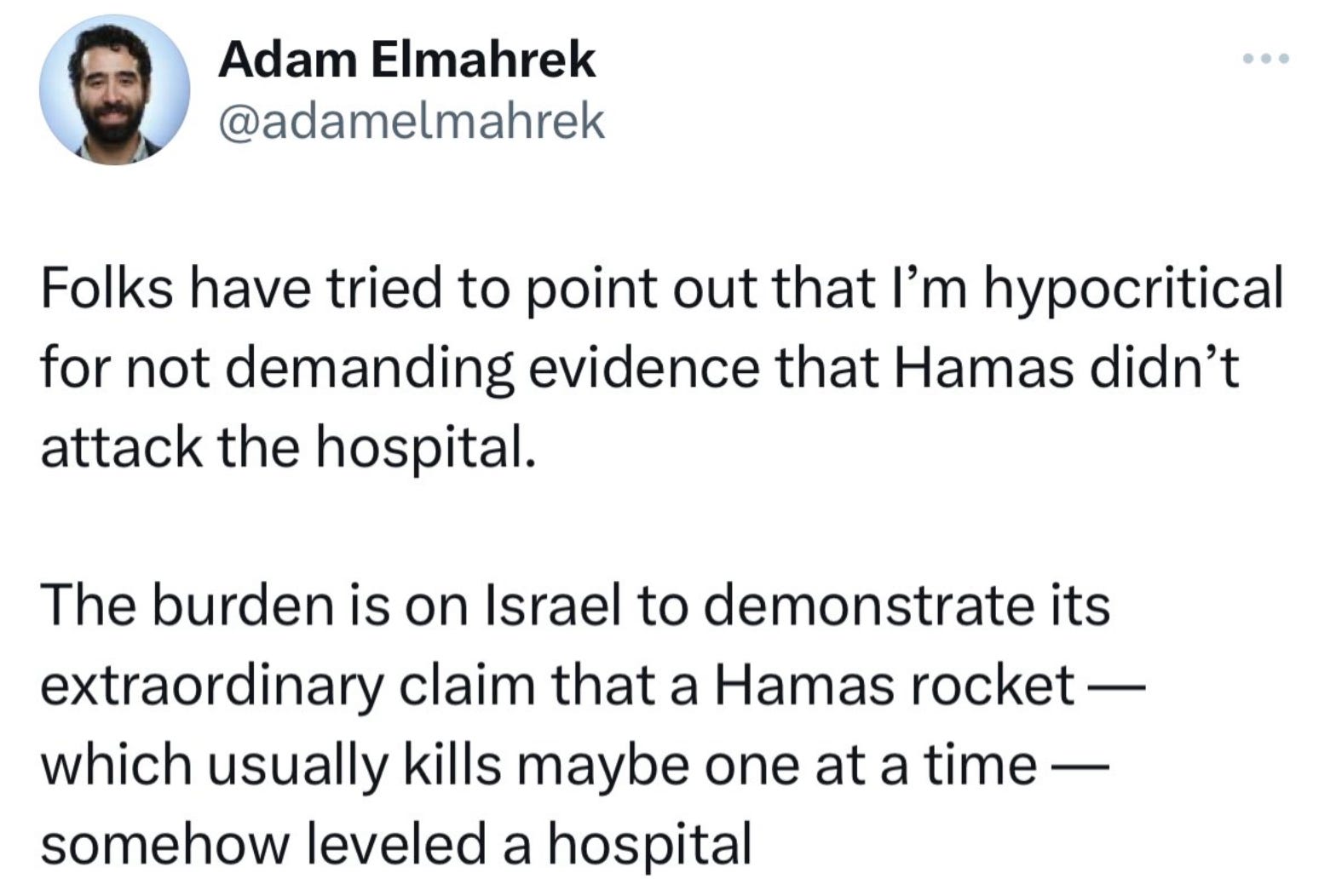

In the fog of war, it’s often said the first casualty is truth. I’ve come to discover over the past year that that adage also applies to churches in the fog of schism. Very often, perception trumps truth.
Having spent my past working career as a journalist seeking to discern TRUTH from falsehood, I suppose I am a “high truth guy.” But the importance of telling the truth and of seeking to discern it has been underscored in my five years as the communications person for Beverly Heights. One of my earliest experiences in this position was writing about Covid.
I quickly discovered then how much truth mattered. The government was shutting down schools and churches based on flawed mandates that were illogical and not founded on the actual science. I encountered violations against free speech and free worship, some so grotesque I never thought I’d see them in this country.
The lesson I learned then is that science cannot function effectively without free speech. Nor can our other cherished institutions, including religion. You may not recall the extreme actions that some states and the federal government took during Covid. This trailer for the excellent documentary The Essential Church will refresh your memory.
TRUTH matters, now more than ever. Folks widely assert nowadays that truth is merely perception. “I have my truth, you have yours.” So says the widespread falsehood of our age. But in the last five years, I have come to appreciate the threat this canard represents to our faith. Truth based on “perception” can do grave harm to believers, churches and the Kingdom of Jesus Christ.
It can also do grave harm to pastors. In the case waged against Pastor Nate, I am absolutely convinced that perception trumped truth. He was laboring under the burden of guilty until proven innocent. I do not know what to attribute it to. Some of his defenders have called it “Nate Derangement Syndrome.”
But regardless of the reasons for it, it was unfair to him and the people who support him. I would also contend that it was un-American.
It’s worth noting that when our nation’s Founding Fathers wrote the Bill of Rights in 1789, they authored a document that guarantees the American tradition of due process. Five of the 10 Amendments in the Bill of Rights – Amendments Four through Eight – recognize the importance of due process in any judicial proceeding and the right of a person accused of crimes to confront his accusers. In biblical terms, to seek personal repentance, one on one.
But strangely, Nate was never granted the presumption of innocence, as would normally be accorded to anyone charged with a crime or offense. And even worse, especially so for clergy, he was never given the chance to refute the charges against him or prove his innocence.
Rev. Dr. T. David Gordon, an ordained pastor in the conservative Presbyterian Church in America and a longtime friend of this congregation, made a similar point in a recent email to me. I had shared information about Nate’s situation with him, including his resignation letter and the AC’s Sept. 16 report.
T. David will be guest preaching from our pulpit on Nov. 12 as well as teaching an ACE class that day in our current class series “Right Alignment,” on our disagreements with the EPC. His class topic will be the history of modern Presbyterianism. He has taught in our ACE program frequently in the past and is a former professor at Gordon-Conwell Theological Seminary and Grove City College.
Here are his comments. As usual, they are most insightful:
“Until several years ago, we imagined that cancel culture was only a tactic among the far left; it is evident now that it has absorbed the right also. Feelings/impressions/subjective appraisals are granted carte blanche, replacing due process, which amounts to a repudiation of the American tradition,” he noted.
“We now live in an era where due process is not so much violated but evaded; significant decisions are made outside of the civil or ecclesiastical courts, which renders them immune to appeal to higher judicatories. … Was [Nate] afforded any kind of due process, or was he merely bullied/threatened? If so, it is another example of cancel culture.”
Perhaps the greatest irony of this entire affair is that Nate was initially accused of bullying, but wound up being the one who was bullied.
The POA sought to restore the peace, unity and purity of the church, but furthered the problem by avoiding the pathway of justice and due process. This is what cancel culture looks like in the church.
Before closing, I’d like to underscore Nate’s message in his final sermon. The video of it is below. While there are many things I will miss about Pastor Nate Devlin, his preaching is at the very top of a long list.
His subject was gratitude. It is a good subject for all of us to reflect on.
“Show gratitude for all that God has done,” Nate said, recalling his nearly 20-year association with Beverly Heights. “You have loved me, you have loved my family, you have given to us in abundance, you have showered us with opportunity and I am grateful.”
I, too, am grateful – for Nate’s presence among us these past 20 years, and for the many ways the Lord used him in his ministry here.
May we as followers of Jesus be grateful for the abundance of blessings that our Lord showers upon us. God bless.