
Tuesday, August 9, 2022
Good afternoon.
I am always on the lookout for useful social media memes to best sum up the confusion I encounter in my monthly jaunts through the news.
Lately, things have gotten so nutty that it has become hard to capture, with precision, the unreality of it all.
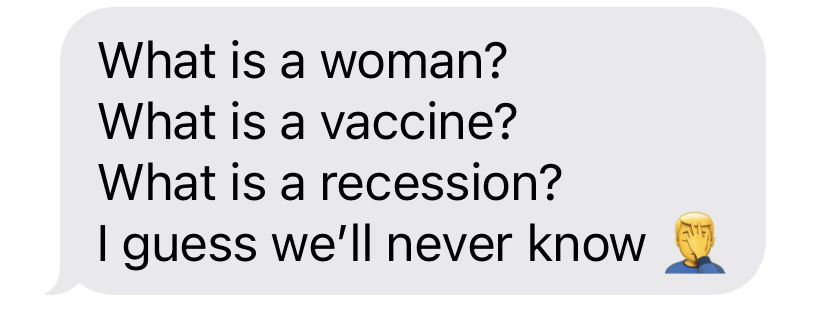
Thankfully, my son Brendan, a resident of that Apex of Eccentricity – also known as Los Angeles County, California – offers up occasional assistance. The text he shared with me below nicely sums up three relevant questions which surfaced during the past month. I will address these questions in the same sequence of his text.

What is a woman?
There was a time not that long ago when answers to the question above were universally agreed upon. A woman was a “she” or “her,” while a man was a “he” or “him,” as defined by their respective chromosomes, reproductive organs and pronouns.
The earth was not flat then because a few over-zealous ideologues said it was.
There was no dispute on this point among our scientists, our media, our universities, our churches, our corporate executives, our law schools, our hospitals, our local governments or our elementary schools. Gender was a settled question.
The flat, upside-down world came upon us quickly. When asked to define a woman, Supreme Court justices didn’t decline to answer the question as Judge (now Justice) Ketanji Brown Jackson did during her confirmation hearing last March.
An important precedent in the new world we were about to enter was set in 2015 when the U.S. Supreme Court decided, in a landmark 5-4 decision, to recognize the legal validity of gay marriage. Though many Americans disagreed with it, the decision was accepted. No fence went up around the Supreme Court, as it did in recent months before Roe v. Wade was reversed, and national abortion rights were invalidated.
“But about a month after [the decision validating gay marriage], the transgender rights issue erupted, focusing – incredible in retrospect – on bathroom access. … the culture war reignited,” writes columnist Daniel Henninger in the Wall Street Journal, recounting the recent history of how we got from there to here. The Trump presidency and the pandemic put these partisan trends into hyper drive.
So much so that within just seven years, the transgender rights issue now extends to primary education, and the instruction of first-graders even over parental objection.
We have witnessed that here, in our own community and Mt. Lebanon School District, of how quickly then became now. In June, a federal lawsuit was filed against a teacher, the district and administrators as three courageous parents seek to restrain a reckless “educator” who refused to stop instructing first-grade students on gender change this past school year at Jefferson Elementary School.
The rapidity of this change has come at warp speed and carries with it frightening implications, chilling to people on both the left and right.
Here is what former New York Times columnist Bari Weiss – a gay woman married to her female partner (Nellie Bowles) and living in San Francisco – says about what she (that’s her preferred pronoun) calls our current “revolution of culture.”
“What has become obvious to anyone paying attention is that we are living through a kind of revolution,” she writes in this recent commentary. “In this ideology, disagreement is recast as trauma. So speech is violence.”
Carl Trueman, a thoroughly orthodox and conservative-minded Christian, offers the same assessment in a recent essay of his: “In this new world, the failure to affirm particular identities is seen as an act of oppression and even at times described using the language of violence,” he writes.
Whenever intelligent social commentators on opposite political sides draw the same conclusion, it is noteworthy in a society where seldom the twains meet.
Their common perspectives helped me make sense of the amazing exchange I viewed in the past month between Republican Senator Josh Hawley, of Missouri, and Khiara Bridges, a University of California Berkeley law professor. The occasion was a Senate Judiciary Committee hearing on July 12. Broadcast on C-Span, it went viral. You may view it by clicking on the link immediately below.
The video explores a seemingly absurd question: can men get pregnant?
No, you’d say, men cannot get pregnant. I agree. So does Senator Hawley, stating what seems to be self-evident. Wrong, Ms. Bridges counters. Here is a partial transcript of their exchange.
Sen. Hawley: Professor Bridges, … you’ve used a phrase; I want to make sure I understand what you mean by it. You’ve referred to “people with a capacity for pregnancy.” Would that be women?
Ms. Bridges: Many women, cis women, have the capacity for pregnancy; many cis women do not have the capacity for pregnancy. There are also trans men who are capable of pregnancy as well as nonbinary people who are capable of pregnancy.
Sen. Hawley: So, this isn’t really a women’s rights issue. It’s – it’s what? …
Ms. Bridges: So, I want to recognize that your line of questioning is transphobic and it opens up trans people to violence by not recognizing them.
Sen. Hawley: Wow. You’re saying that I’m opening up people to violence by asking whether or not women are the folks who can have pregnancies? … I’m denying that trans people exist by asking you if you’re talking about … women having pregnancies?
Ms. Bridges: Do you believe that men can get pregnant?
Sen. Hawley: No, I don’t think men can get pregnant.
Ms. Bridges: So, you are denying that trans people exist. Thank you.
Pardon me while I splash cold water on my face. There’s a lot to unpack and decipher here.
First, be aware that the word “woman” is now verboten in the trans movement and among extremists like Ms. Bridges. “Womb bearers” or “people with the capacity for pregnancy” is the new authorized language because gender is what a person declares it to be. Depending on when a trans person changed gender, that person may still have the reproductive organs of their prior gender if the transition took place after puberty, as it often does.
By his questioning, Senator Hawley is denying the existential tenet of the trans movement: that gender is fluid. A “man” can indeed get pregnant, according to this tortured logic, because “he” is still a she in terms of her reproductive organs. Nature is fixed, not fluid. It cannot be altered by mere declaration (or even effectively, by surgical procedure). It does not become that which we wish it to be.
Asking questions “opens up trans people to violence by not recognizing them,” Ms. Bridges alleges – the very point both Bari Weiss and Carl Trueman explain above. Speech is violence, as they said.
Got that? A whiteboard may be required to diagram this one. Why bother, you may ask? Here’s why.
“Now our culture is telling us that the differences between boys and girls don’t matter. That if you identify as something, you are that thing. How do we help our kids make sense of this when they are bombarded by conflicting messages about gender and identity?” asks conservative commentator Matt Walsh, a father of four, in the opening scene of What is a Woman?
Here is the trailer for this new blockbuster documentary, produced by the Daily Wire. (You have to be a member to view the entire feature-length film, which I recommend; it’s worth the price of admission. Carl Trueman is one of the guests featured in it.)
Clearly, we are failing as a society to help our kids make sense of conflicting messages about gender and ideology. People put up yard signs saying “We love you,” without considering the implications such advocacy may have for their children.
“Victimhood, in this ideology, confers morality,” Bari Weiss astutely observes in her essay, referenced earlier.
Recently a Pew survey found that 5% of young Americans now self-identify as transgender. That’s a huge increase in just a few years. Zealots allege this proves that more aggressive medical inventions are absolutely essential for “gender dysphoric children.”
Predictably, President Biden in June signed an executive order banning any federal funds from “conversion therapy,” which trans activists call it when teen girls go to a therapist before getting a mastectomy. But even trans doctors who provide assistance to children and adolescents are expressing concern about over-medicalizing young folks too quickly.
The U.K. is ahead of us in recognizing the danger of prescribing puberty blockers to children. The British government recently ordered England’s only children’s trans clinic to close after whistleblowers inside the Tavistock clinic triggered an independent review. Children were reportedly referred for puberty blockers after just one consultation at Tavistock. Last month, the U.S. FDA issued a warning of the dangers of puberty blockers, linking them to brain swelling and permanent vision loss.
Liberal comedian Bill Maher, of all people, has emerged as one of the few sane voices on this subject. In this refreshingly honest (and very funny) monologue, he offers up some absolute gems of common sense.
“Something about the human race is changing at a previously unprecedented rate,” he begins. “We have to at least discuss it. Broken down over time, the LGBT population of America seems to be roughly doubling every generation. … Which means if we follow this trajectory, we will all be gay in 2054.”
The news I interpret in this report each month is by definition discouraging. The world can be a discouraging place. As Christians, however, discouragement is not an option, the Bible tells us. Instead, we’re advised to embrace the one thing the culture can never claim, which all humans yearn for: HOPE. And our HOPE is built on nothing less than Jesus’ blood and righteousness.
In responding to the culture and to the vast societal problems vexing us as Christians – which are pernicious and inevitably impact the church itself and its members – faithfulness is key, Carl Trueman writes in the essay I mentioned above entitled, “Faithfulness is the Future of the Church.”
“Faithfulness to the gospel message in our teaching, practice and worship, and to the fact that believers are made in the image of God, redeemed by the blood of the Son, and called to reflect his character to the world around,” he writes. I encourage you to read his essay. Carl’s diagnosis of what ails us societally, and our appropriate response as Christians, is incisive, thought provoking and convicting.
We must push on, being in the world but not of it, captured by the Holiness of God and enraptured by the power of Jesus’ Grace in a fallen and utterly confused world.
Confusion … that’s a perfect segue for the second question: what is a vaccine?
It wouldn’t be at all unreasonable to be asking that question by now. Vaccines were supposed to stop Covid from spreading. We were told, incessantly, that they would. The federal government and private businesses went so far as to mandate vaccination on the premise that it would eradicate the virus, if you recall, shaming and even firing those who refused to get jabbed.
In fact, the nation’s first class-action lawsuit for unvaccinated healthcare workers (whose religious rights were unlawfully denied) was just settled. As a result of the settlement, NorthShore University Health System in Chicago will pay $10 million to compensate more than 500 current and former employees who were victims of religious discrimination.
Both Dr. Anthony Fauci and President Biden are among the most vaccinated and boosted persons in the United States, yet each has gotten recent cases of Covid (in Mr. Biden’s case, twice). “We are in a pandemic of the quadruple vaccinated,” the satirical Babylon Bee quips. Sadly, it is not far from the truth.
Although I do not doubt that being vaccinated lessens the severity of Covid if you get it, it is now clear to anyone paying attention that the vaccines have not done what they were supposed to do. President Biden and his top infectious disease expert bet far too heavily on them as a public-health strategy in the mistaken belief that it would eradicate the virus, as this story in the Wall Street Journal explains.
“It’s like a horror movie I’m being forced to watch and I can’t close my eyes,” one senior federal health official laments in this separate story, by Dr. Marty Makary of the Johns Hopkins School of Medicine. It describes how federal agencies, with no solid clinical data, have authorized Covid vaccines for infants and toddlers, including those who already had Covid. “People are getting bad advice and we can’t say anything.”
It’s also now clear that the chief achievement of the shutdowns that the federal government and many Blue states mandated (such as Pennsylvania) was to greatly disrupt business supply chains, greatly increase government spending and thereby aggravate inflation. The ripple effects from the shutdowns have been felt widely in many health outcomes unrelated to the virus but nonetheless affected by our response to it, including increased death from heart disease and stroke; drug and alcohol use; suicide; firearms; and reckless driving.
Never get between a mom and her cubs. The shutdowns have also caused an intense political backlash among parents, the New York Times reports.
The Times interviewed 27 parents who all had similar stories about switching their viewpoints. “Most said they were worried about their kids being isolated during school lockdowns and fought to reopen schools – nearly all blamed legislators for the shutdowns,” the Daily Wire reports in this podcast.
If you want to send your head spinning on the subject of shutdowns, read this Washington Monthly magazine piece. It explains how – incredibly – Sweden didn’t lock down at all and yet fared far better in its public-health outcomes than the United States did.
In Sweden, kids under 16 stayed in school. Restaurants stayed open. Businesses were not destroyed and people were not laid off. The societal disruption was minimized.
And yet: “Researchers found that among 11 wealthy peer nations, Sweden was the only one with no excess mortality among individuals under 75. None, zero, zip.” The U.S. fared worst in excess mortality among the 11 countries studied.
Such are the lessons learned from our failed strategies in combatting Covid. All the shutdowns we endured were pointless, except in one very important aspect which we are now dealing with: they brought extraordinary economic disruption and, with it, a new public enemy No. 1, inflation.
Which brings us to the third and final question: what is a recession?
Back when I studied economics in college, the standard definition of a recession could be found in Nobel Laureate Paul Samuelson’s classic text. A recession was defined as “a period in which real Gross Domestic Product declines for at least two consecutive quarters.” Which is exactly what occurred when the U.S. economy contracted 0.9% in the April-June quarter, following a 1.6% contraction in the first three months of the year.
The reason the economy has contracted is because the Federal Reserve (which spent most of last year calling inflation “transitory” and therefore of little concern) has begun increasing interest rates to fight the worst inflation (9%) that we’ve seen since I was reading Mr. Samuelson’s book in the 1970s. The Fed is trying to slow economic activity and hiring to bring down inflation.
How long this contraction will last, and severe it will be, is anyone’s guess. But it’s politically inconvenient, with the midterm elections this November.
Even before the second-quarter decline was announced, the Biden administration set out on a campaign to redefine the definition of recession. Big Tech is also lending its support. Wikipedia is keeping its recession entry, with the new Biden-approved definition, locked for edits.
Why not? If a man can now get pregnant, redefining a slump in the economy seems like a piece of cake. It may be creepy – shades of George Orwell’s 1984 – but what isn’t these days?
That’s my report for August. See you next month. Until then, may the Lord bless you and keep you.